
Contents
- The first mileage rate rise in 15 years
- Old vs new rates
- Example 1: employee whose company pays the old rate
- Calculator: Mileage Allowance Calculator
- Example 2: self-employed driver on simplified expenses
- Example 3: employer already paying more than 45p
- What else is in the Taxation (Energy and Vehicles) Bill
- Common mistakes to avoid
- Your action checklist
- Who this change affects
- If this is you, do this
- How long a claim takes
- Sources
The first mileage rate rise in 15 years
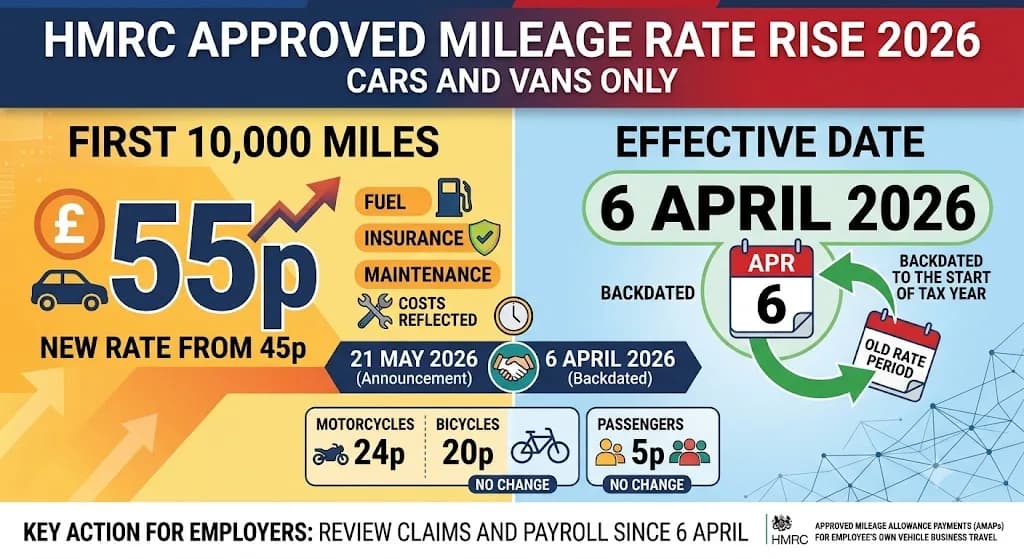
The headline HMRC mileage rate for cars and vans is rising from 45p to 55p per mile for the first 10,000 business miles in the tax year. The government announced the increase on 21 May 2026, and the legislation to deliver it sits in the Taxation (Energy and Vehicles) Bill, presented to Parliament on 24 June 2026. Crucially, the change is backdated to 6 April 2026, so every business mile you have driven since the start of this tax year already counts at the new rate.
This is the first change to the Approved Mileage Allowance Payment (AMAP) rate since 2011/12. Fifteen years of frozen rates meant drivers were absorbing rising fuel, insurance and servicing costs on a 2011 allowance. A 10p rise does not fix all of that, but for a typical 8,000-mile-a-year driver it is worth £800 more tax-free allowance every year.
Old vs new rates
| Vehicle | Rate to 2025/26 | Rate from 2026/27 | Change |
|---|---|---|---|
| Car or van, first 10,000 miles | 45p per mile | 55p per mile | +10p |
| Car or van, above 10,000 miles | 25p per mile | 25p per mile | No change |
| Motorcycle | 24p per mile | 24p per mile | No change |
| Bicycle | 20p per mile | 20p per mile | No change |
| Passenger rate (per colleague) | 5p per mile | 5p per mile | No change |
The same 55p figure also flows through to the simplified expenses flat rate that self-employed people use for vehicle costs, because the Bill amends both the employee rules (section 230 of ITEPA 2003) and the trading rules (section 94F of ITTOIA 2005). Electric and hybrid cars use the same rates as petrol and diesel.
Example 1: employee whose company pays the old rate
Marcus does 8,000 business miles a year in his own car and his employer reimburses him at 45p per mile. Here is his position for 2026/27:
| Line | Amount |
|---|---|
| Employer pays 8,000 miles at 45p | £3,600 |
| HMRC approved amount: 8,000 miles at 55p | £4,400 |
| Shortfall he can claim Mileage Allowance Relief on | £800 |
| Tax back at basic rate (20%) | £160 |
| Tax back at higher rate (40%) | £320 |
His employer does not have to raise its rate to 55p, but until it does, Marcus should claim the relief himself through Self Assessment or a P87 claim. Our Mileage Allowance Calculator works this shortfall out for you, and the Mileage Tracker keeps the log HMRC expects to see.
Work it out for your own figures
Open the full Mileage Allowance Calculator →Your business mileage
Work out the tax-free mileage allowance you can claim under HMRC's Approved Mileage Allowance Payments (AMAP).
Miles carrying colleagues on business - worth an extra 5p each.
Leave at 0 if your employer pays nothing. We compare it against the AMAP rate.
Used to estimate the tax relief on any shortfall (Mileage Allowance Relief).
AMAP rates: cars/vans for the first miles then ; motorcycles ; bicycles per mile.
Tax-free allowance you can claim
for business miles by
- First miles @
- miles @
- passenger miles @ 5p
- miles @
- Total allowance
Your employer underpays the AMAP rate
unclaimed shortfall
tax relief you can claim
Claim Mileage Allowance Relief on the difference via your tax return or a P87.
Your employer meets or exceeds the AMAP rate
Anything above the AMAP rate () is taxable and should appear on form P11D.
Estimate only. AMAP covers fuel, insurance, servicing and depreciation.
Allowance across the mileage range
claimNotice the line gets shallower past miles, where the rate drops from to .
Compare saved scenarios
| Scenario | Miles | Allowance | Relief | |
|---|---|---|---|---|
Example 2: self-employed driver on simplified expenses
Priya is a self-employed courier who drove 12,000 business miles this year and uses the flat-rate mileage method instead of actual vehicle costs:
| Calculation | Old rules | New rules |
|---|---|---|
| First 10,000 miles | 10,000 x 45p = £4,500 | 10,000 x 55p = £5,500 |
| Next 2,000 miles | 2,000 x 25p = £500 | 2,000 x 25p = £500 |
| Total deduction | £5,000 | £6,000 |
That extra £1,000 deduction cuts her taxable profit. As a basic-rate taxpayer she saves 20% income tax plus 6% Class 4 National Insurance, so the rise is worth about £260 a year to her. Check your own numbers with the Self-Employed Tax Calculator.
Example 3: employer already paying more than 45p
Some employers pay 50p or 55p per mile and, until now, anything above 45p was taxable as extra pay. From 2026/27 an employer can pay up to 55p per mile for the first 10,000 miles with no tax or National Insurance at all. An employee doing 6,000 miles at 55p receives £3,300 entirely tax-free; under the old rules £600 of that would have been taxed through the payroll.
What else is in the Taxation (Energy and Vehicles) Bill
- Electricity Generator Levy rises from 45% to 55% on exceptional receipts from 1 July 2026.
- Vehicle Excise Duty holiday for HGVs: a temporary 12-month VED exemption for certain heavy goods vehicles applies from 1 July 2026 to 30 June 2027.
- What is not in it: the pay-per-mile charge for electric vehicles (eVED) announced at the 2025 Budget. That is still planned for April 2028 at 3p per mile for EVs and 1.5p for plug-in hybrids, but it will need its own legislation. You can estimate the future cost with our EV Pay-Per-Mile Tax Calculator.
Common mistakes to avoid
- Forgetting the backdating. Miles driven since 6 April 2026 qualify at 55p even though they happened before the announcement. Do not claim them at 45p.
- Applying 55p above 10,000 miles. The over-10,000 rate stays at 25p.
- Claiming without records. HMRC expects a mileage log with dates, journeys and business purpose. A diary entry per trip is enough; reconstructed guesses are not.
- Missing the passenger rate. Carrying a colleague on a business journey still adds a tax-free 5p per mile on top.
Your action checklist
- Start logging business miles now if you are not already; the Mileage Tracker makes it painless.
- Employees: check what rate your employer pays and claim relief on any gap below 55p.
- Self-employed: use 55p for the first 10,000 miles of 2026/27 when you file, and compare the flat rate against actual costs with the Expenses Checker.
- Employers: decide whether to raise reimbursement rates to the new tax-free maximum and update your expenses policy.
Who this change affects
| You are... | What the 55p rate means for you |
|---|---|
| An employee using your own car for work trips | Your employer can now pay 55p/mile tax-free; if they pay less, you claim tax relief on the gap |
| Self-employed using simplified expenses | Your deduction per business mile rises from 45p to 55p, backdated to 6 April 2026 |
| A care worker, district nurse or multi-site worker | You are in the group with the most miles and the biggest backdated claims |
| An employer | You can raise reimbursement to 55p without creating taxable pay; below it, expect P87 claims |
| A volunteer driver | Approved rates apply to volunteer mileage payments too |
| Commuting to one regular workplace | No claim: ordinary commuting has never qualified |
If this is you, do this
| Situation | Meaning | Decision | Action |
|---|---|---|---|
| Employer pays 45p, you drive 5,000+ business miles | 10p/mile of relief unclaimed | Claim it | Form P87 online (free); 5,000 miles = £500 gap = £100 back at basic rate, £200 at higher |
| Employer pays 55p or more | Fully reimbursed; excess above 55p is taxable | Nothing to claim | Check payslips treat any excess correctly |
| Mileage between 6 April and the rate change announcement | Backdated to 6 April 2026 | Include it | Count ALL 2026/27 business miles at the new rates in your claim |
| Self-employed, doing accounts | Deduction rate changed mid-habit | Update your log rate | 10,000 miles at 55p then 25p after; do not mix old 45p into 2026/27 |
| Past years underclaimed at 45p | Old years use old rates | Still claim, correctly | Up to 4 years back at the rates that applied then |
| No mileage log | Claims need evidence | Rebuild, then keep one | Diaries, job sheets and maps apps are acceptable reconstruction; the mileage tracker keeps it going forward |
How long a claim takes
| Step | Typical timeline |
|---|---|
| P87 submitted online | Decision usually within a few weeks |
| Refund for the current year | Through your tax code: pay rises slightly for the rest of the year |
| Refund for previous years | Bank transfer or cheque after processing |
| Self-employed | Relief lands inside your next Self Assessment bill |
All figures checked against HMRC published rates on 27 July 2026.
Sources
Frequently asked questions
When does the 55p mileage rate start?
Does the 55p rate apply to electric cars?
My employer still pays 45p per mile. Can I claim the difference?
Did the rate for miles over 10,000 change?
Is commuting covered by the 55p rate?
Is this the same thing as the pay-per-mile tax for electric cars?
Read next
More News →
Mileage claims for the self-employed: flat rate vs actual costs
The self-employed can claim business mileage using the simplified flat rate of 55p a mile for the first 10,000 miles and…
Tax on Savings Interest 2026/27: The Personal Savings Allowance
With savings rates the highest in years, more people are breaching their Personal Savings Allowance - £1,000 for…

Stamp Duty 2026: What You Pay and First-Time Buyer Relief
In England and Northern Ireland, Stamp Duty Land Tax now starts at £125,000, with first-time buyers paying nothing up to…
Rather someone else did it?
Partner linksFixed-fee services where a qualified accountant prepares and files your return.
TaxScouts
A real accountant files your return for one fixed fee.
Fixed fee, typically about £169 per return
Get my return doneGoSimpleTax
DIY Self Assessment software that checks for missed savings.
From about £54.99 per tax year
File it myselfWe may earn a commission if you sign up through one of these links. It never changes what we calculate, what we recommend, or the order they appear in.