News
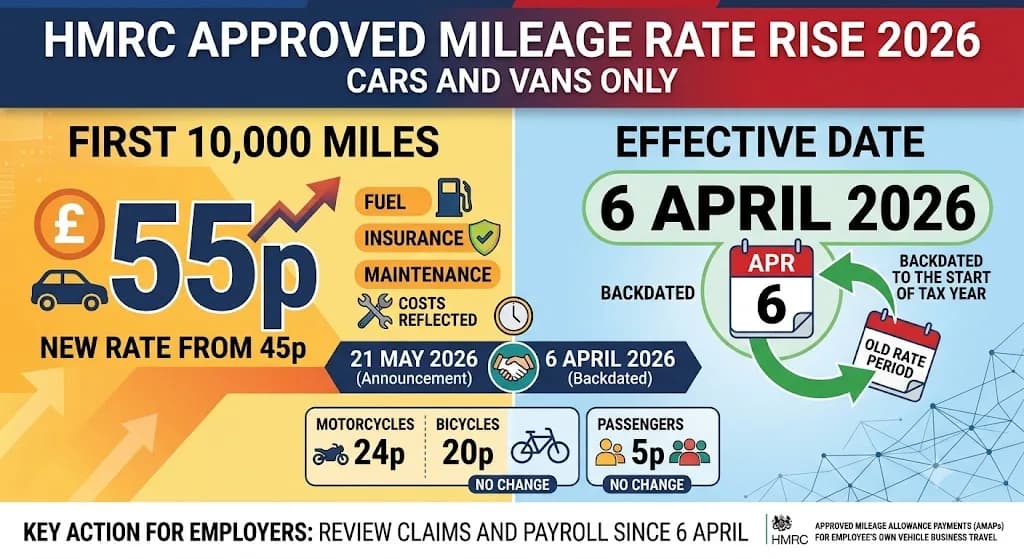
HMRC Mileage Rate Rises to 55p a Mile, Backdated to 6 April 2026
The approved mileage rate for cars and vans rises from 45p to 55p per mile for the first 10,000 business miles, the…

This mileage calculator works out your tax-free mileage allowance using HMRC's Approved Mileage Allowance Payments (AMAP) rates for the 2026/27 tax year. Enter your business miles and the vehicle you use, and it shows what you can be paid tax-free, and how much relief you can claim if your employer pays you less than the approved rate.
It's built for employees who use their own car, van, motorbike or bike for work, and for sole traders using simplified mileage. It does not cover your ordinary commute, which never qualifies.
Work out the tax-free mileage allowance you can claim under HMRC's Approved Mileage Allowance Payments (AMAP).
Miles carrying colleagues on business - worth an extra 5p each.
Leave at 0 if your employer pays nothing. We compare it against the AMAP rate.
Used to estimate the tax relief on any shortfall (Mileage Allowance Relief).
AMAP rates: cars/vans for the first miles then ; motorcycles ; bicycles per mile.
Tax-free allowance you can claim
for business miles by
Your employer underpays the AMAP rate
unclaimed shortfall
tax relief you can claim
Claim Mileage Allowance Relief on the difference via your tax return or a P87.
Your employer meets or exceeds the AMAP rate
Anything above the AMAP rate () is taxable and should appear on form P11D.
Estimate only. AMAP covers fuel, insurance, servicing and depreciation.
Notice the line gets shallower past miles, where the rate drops from to .
| Scenario | Miles | Allowance | Relief | |
|---|---|---|---|---|
These are the HMRC approved mileage allowance payment (AMAP) rates for the 2026/27 tax year. Your employer can pay up to these amounts tax-free. If they pay less, you can claim tax relief on the difference; if they pay more, the excess is taxable.
| Vehicle | First 10,000 business miles | Each mile over 10,000 |
|---|---|---|
| Cars and vans | 55p | 25p |
| Motorcycles | 24p | 24p |
| Bicycles | 20p | 20p |
Enter your total business miles, choose your vehicle, and add anything your employer already pays you per mile. The tool above returns your approved tax-free figure and any shortfall you can reclaim. The sections below show exactly how that number is reached so you can sense-check it against your own records.
When you use your own vehicle for work, HMRC lets your employer reimburse you a set amount per business mile completely free of tax and National Insurance. These are the Approved Mileage Allowance Payments, usually shortened to AMAP. The rates are designed to cover everything that running the vehicle costs you: fuel, insurance, road tax, servicing, repairs and the wear that knocks value off the car.
The headline 55p mileage rate applies to cars and vans for the first 10,000 business miles in the tax year. It rose from 45p on 6 April 2026, the first increase since 2011, and the rise is backdated so every business mile driven since the start of the tax year counts at the new rate. Above 10,000 miles the rate drops, because the fixed costs of owning the vehicle have already been covered. The plain-English formula is:
Tax-free allowance = (first 10,000 miles × 55p) + (miles above 10,000 × 25p)
The rates are the same whether you drive a petrol, diesel, hybrid or fully electric car. AMAP does not distinguish by fuel type, so an EV driver claims the same 55p as anyone else. Motorcycles and bicycles have their own flat rates that apply to every mile, with no 10,000-mile step.
If your employer pays you the approved amount or less, none of it is taxable. If they pay more than the approved rate, the excess counts as taxable pay and goes through payroll. If they pay you less than the approved amount, or nothing at all, you can claim the difference back through Mileage Allowance Relief (MAR). Relief is given at your marginal income tax rate, so a basic-rate taxpayer gets 20% of the shortfall back and a higher-rate taxpayer gets 40%.
These are the approved rates per business mile. Source: gov.uk travel and mileage allowance payments, checked for the 2026/27 tax year. The car and van rate rose from 45p to 55p for 2026/27; the increase is being legislated in the Taxation (Energy and Vehicles) Bill and applies retrospectively from 6 April 2026.
| Vehicle | First 10,000 miles | Over 10,000 miles |
|---|---|---|
| Car or van | 55p | 25p |
| Motorcycle | 24p | 24p |
| Bicycle | 20p | 20p |
If you carry a colleague on the same business trip, you can claim an extra 5p per passenger per mile on top, tax-free. This passenger payment is only available to employees, not the self-employed, and your employer has to choose to pay it.
Say you're a community nurse who drives 12,000 business miles a year visiting patients in your own car. Your approved allowance is:
Now suppose your employer reimburses you a flat 25p a mile. That pays you 12,000 × 25p = £3,000. Because the approved figure is £6,000, you have a shortfall of £6,000 − £3,000 = £3,000 that was never reimbursed.
You claim Mileage Allowance Relief on that £3,000. As a basic-rate taxpayer the relief is £3,000 × 20% = £600 back. If you pay higher-rate tax, the same shortfall is worth £3,000 × 40% = £1,200. The relief reduces your tax bill; it isn't a cash payment of the full £3,000.
If you're self-employed and drive 8,000 business miles in your van, you claim the AMAP rate as a business expense instead of working out actual running costs. That's 8,000 × 55p = £4,400 deducted from your profit before tax. On profit taxed at the basic rate, that deduction saves you roughly £4,400 × 20% in income tax, plus Class 4 National Insurance on the same slice. You can model the full picture with our self-employed tax calculator once you've fixed your mileage figure.
One catch for sole traders: once you use simplified mileage for a particular vehicle, you must keep using it for that vehicle until you stop using it for the business. You can't switch to claiming actual fuel and repair costs partway through.
Business mileage is travel you have to do for your job, not your normal journey to a permanent workplace. You can claim for:
You cannot claim for your ordinary commute from home to a permanent office, even on a day you also pop out to a meeting. Getting this line wrong is the single most common reason a mileage claim is challenged. Keeping a simple log helps; our mileage tracker records the date, route, purpose and miles for each trip so your figure stands up if HMRC asks.
The AMAP rates themselves are UK-wide, so a driver in Glasgow claims the same 55p as one in Cardiff. What differs is the value of the relief, because it's given at your income tax rate. Scotland sets its own income tax bands, so a Scottish taxpayer in the 42% intermediate or higher band gets relief at 42% on the shortfall, rather than the 40% that applies in England, Wales and Northern Ireland. The miles you claim are identical; the tax saved depends on where you're taxed.
If your total unreimbursed mileage relief for the year is £2,500 or less, you can claim using form P87 online through your Government Gateway account. If it's more than that, or you already file a return, claim it through Self Assessment. You can usually backdate claims up to four tax years, so it's worth checking past years if you've never claimed. For wider job costs beyond driving, our work expense tax rebate calculator covers tools, uniforms and professional fees too.
For a sense of what each mile actually costs you to run versus what you're reimbursed, the cost per mile calculator is a useful companion. If you want to check the rules straight from the source, MoneyHelper has a plain-English overview at moneyhelper.org.uk.
These figures are estimates for guidance only and are not personal tax or financial advice. Check your own records and the current gov.uk rates before submitting a claim.
For employees and the self-employed claiming business mileage in their own vehicle. HMRC’s approved rates are 45p per mile for the first 10,000 business miles in a tax year and 25p after that — and the drop at 10,000 catches out high-mileage drivers who budget on 45p throughout.
The important distinction is what you can claim. If your employer pays you nothing, you claim tax relief on the full approved amount — meaning you get back your marginal tax rate of it, not the whole sum. If your employer pays less than the approved rate, you claim relief on the shortfall. If they pay more, the excess is taxable.
The approved mileage rate for cars and vans rises from 45p to 55p per mile for the first 10,000 business miles, the…
The self-employed can claim business mileage using the simplified flat rate of 55p a mile for the first 10,000 miles and…
You can normally take 25% of your pension as a tax-free lump sum, capped at £268,275. Here is exactly how the rule works…
If you keep your own books, these are the packages that handle Self Assessment and Making Tax Digital.
The freelancer and contractor favourite, free with some bank accounts.
From £0 with a NatWest, RBS or Mettle account, otherwise about £19/mo
See FreeAgentThe big all-rounder with the deepest MTD track record.
From about £10/mo, frequent 90% off intro offers
See QuickBooksThe scale-up choice once you have staff, stock or VAT.
From about £15/mo
See XeroWe may earn a commission if you sign up through one of these links. It never changes what we calculate, what we recommend, or the order they appear in.