
Contents
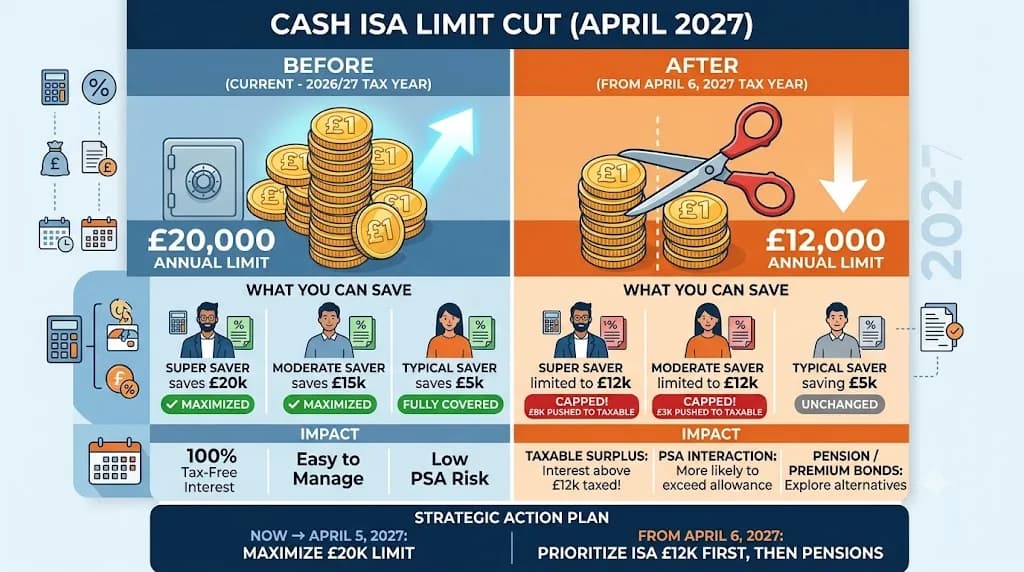
A significant change is coming for cash savers. From 6 April 2027, the amount you can pay into a cash ISA each tax year will be cut to £12,000 for people under 65 — down from the current £20,000. The overall ISA allowance stays at £20,000, but the remaining £8,000 will have to go into a stocks and shares ISA (or another non-cash ISA) if you want to use it. Here’s what it means and how to prepare.
What’s changing, in one table
| Now (to 5 April 2027) | From 6 April 2027 | |
|---|---|---|
| Total ISA allowance | £20,000 | £20,000 (unchanged) |
| Cash ISA limit (under 65) | Up to £20,000 | £12,000 |
| Must go into stocks & shares ISA | £0 | Remaining £8,000 |
Who is affected — and who isn’t
- Affected: under-65s who currently put more than £12,000 a year into cash ISAs.
- Not affected: money already held in cash ISAs — it stays tax-free and can still be transferred.
- Reported exemption: those aged 65 and over are expected to keep the higher cash limit; confirm the final detail on GOV.UK when published.
Why the Government is doing it
Around £300 billion sits in cash ISAs. The Treasury argues that money held for the long term would grow faster in investments, supporting both savers’ returns and UK companies. Whether or not you agree, the direction of travel is clear: cash is being gently steered toward the stock market.
What to do before April 2027
- Use your 2026/27 cash allowance in full — you can still put up to £20,000 into a cash ISA this year.
- Consider a stocks & shares ISA for money you won’t need for 5+ years, so you’re ready to use the £8,000 from 2027.
- Don’t withdraw existing cash ISA money just to react — it keeps its tax-free status where it is.
- Check whether your ISA is flexible, which lets you replace withdrawals in the same year without losing allowance.
See how your ISA could grow over time under cash versus investment returns:
Why the cash ISA still matters: tax on savings
The reason a cash ISA is valuable is that all interest inside it is tax-free, forever, and it doesn’t touch your Personal Savings Allowance. With savings rates higher than in the 2010s, more people are breaching their PSA (£1,000 basic-rate, £500 higher-rate) and paying tax on ordinary savings interest for the first time — which is exactly when an ISA earns its keep.
Check whether your savings interest outside an ISA is now taxable:
Cash ISA vs stocks & shares ISA: the trade-off
The new rules push more savers toward investing, so it’s worth being clear on the trade-off. A cash ISA gives a guaranteed return and no risk to your capital — ideal for your emergency fund and money you’ll need within a few years. A stocks and shares ISA can grow more over the long run but can fall in value, so it suits money you can leave invested for five years or more. Neither is “better” — they do different jobs, and most people benefit from holding both.
The bottom line
From April 2027 the cash ISA limit drops to £12,000 for under-65s, though the £20,000 total allowance and all your existing ISA savings are untouched. If cash is your preference, front-load it: use the full £20,000 cash allowance this tax year, and start thinking about a stocks and shares ISA for the £8,000 you’ll no longer be able to hold in cash from 2027.
Frequently asked questions
What is the cash ISA limit from April 2027?
Does the cash ISA change affect money I already have saved?
Is the £20,000 ISA allowance changing?
What should I do before April 2027?
Are over-65s affected by the cash ISA cut?
Read next
More Savings & ISAs →
ISA Allowance 2026/27: How to Use Your £20,000 Tax-Free Limit
Your ISA allowance 2026/27 is £20,000 per person. Here's how to split it across ISA types, use the LISA bonus, and grow…

ISA Changes 2026/27: Cash ISA Cut, 22% Charge and Transfer Ban
The Cash ISA allowance is being cut to £12,000, a 22% charge hits cash in investment ISAs, and under-65 transfers are…
How Many ISAs Can You Have? The 2026/27 Rules Made Simple
Unlimited ISAs, one £20,000 allowance. How the post-2024 rules work, the Lifetime ISA exception and how to split…
Rather someone else did it?
Partner linksFixed-fee services where a qualified accountant prepares and files your return.
TaxScouts
A real accountant files your return for one fixed fee.
Fixed fee, typically about £169 per return
Get my return doneGoSimpleTax
DIY Self Assessment software that checks for missed savings.
From about £54.99 per tax year
File it myselfWe may earn a commission if you sign up through one of these links. It never changes what we calculate, what we recommend, or the order they appear in.