
Contents
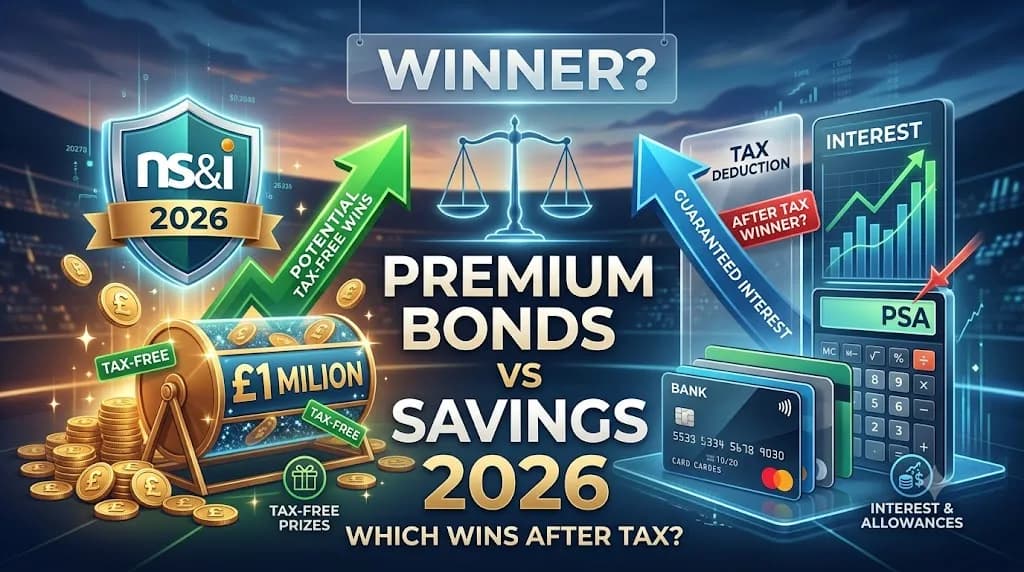
Premium Bonds are the UK’s most popular savings product, held by more than 20 million people — but popular is not the same as optimal. The honest answer to “Premium Bonds or a savings account?” depends on one thing most comparisons skip: tax. This guide compares the real, after-tax return, shows who each option suits, and lets you run your own numbers.
The quick verdict
- Most basic-rate savers: a top easy-access or fixed savings account usually beats Premium Bonds on expected return.
- Higher earners who’ve used their Personal Savings Allowance: Premium Bonds’ tax-free prizes can win.
- Anyone who values the chance of a life-changing win over a small, steady return: Premium Bonds, eyes open.
How Premium Bonds actually work
You don’t earn interest. Instead, every £1 bond is entered into a monthly prize draw, with tax-free prizes from £25 up to £1 million. NS&I sets an annual prize fund rate that represents the average payout across all bonds — but because a few large prizes skew the pot, a typical saver with average luck earns less than that headline rate. Many holders win nothing in a given year.
Estimate what your holding might realistically return:
How savings interest is taxed
Interest from a normal savings account is taxable, but most people have a Personal Savings Allowance (PSA): £1,000 of tax-free interest for basic-rate taxpayers, £500 for higher-rate, and £0 for additional-rate. Below the PSA, savings interest is effectively tax-free too — which is exactly why Premium Bonds’ tax-free status only becomes an advantage once you exceed it.
Check whether your savings interest is now taxable, and by how much:
Worked example: basic-rate saver
Sarah has £20,000 and pays basic-rate tax. A good easy-access account gives her a predictable return, and her interest sits well within her £1,000 PSA, so she pays no tax on it. Premium Bonds would give her, with average luck, a similar-or-lower expected return and a real chance of winning little in any month. For Sarah, the savings account wins — guaranteed, tax-free and accessible.
Worked example: higher earner with used PSA
James is a higher-rate taxpayer whose £500 PSA is already used up by other interest. On his next £20,000 of savings, every pound of interest is taxed at 40%. Premium Bond prizes, by contrast, are completely tax-free. Once you factor in the 40% haircut on the savings account, the expected returns move much closer — and for the portion of his money that would otherwise be taxed, Premium Bonds can come out ahead, with the bonus of a jackpot chance.
Where Premium Bonds genuinely shine
- Tax-free by design: prizes never touch your PSA or tax return.
- 100% capital security: backed by HM Treasury, no risk to your stake.
- Easy access: cash out any time with no penalty.
- The dream factor: a real, if tiny, chance at £1 million.
Where they fall short
- No guaranteed return: average luck often means below-headline; bad luck means nothing.
- Inflation risk: if you win little, your money loses real value over time.
- Better tax-free homes exist: a Cash ISA is also tax-free and pays a guaranteed rate.
So, which should you choose?
Run your own figures rather than trusting a rule of thumb. If you’re a basic-rate saver comfortably inside your PSA, a top savings account or Cash ISA usually gives more, with certainty. If you’re a higher earner whose interest is taxed, or you simply enjoy the tax-free flutter, Premium Bonds earn their place — ideally alongside, not instead of, a proper savings foundation.
Frequently asked questions
Are Premium Bonds better than a savings account in 2026?
Are Premium Bond prizes taxed?
What is the Personal Savings Allowance for 2026/27?
Can I lose money with Premium Bonds?
Read next
More Savings & ISAs →
Premium Bonds Explained: Odds, Prizes and Is It Worth It?
Premium Bonds swap interest for a monthly tax-free prize draw, backed by HM Treasury. We explain how they work, the real…

ISA Allowance 2026/27: How to Use Your £20,000 Tax-Free Limit
Your ISA allowance 2026/27 is £20,000 per person. Here's how to split it across ISA types, use the LISA bonus, and grow…

ISA Changes 2026/27: Cash ISA Cut, 22% Charge and Transfer Ban
The Cash ISA allowance is being cut to £12,000, a 22% charge hits cash in investment ISAs, and under-65 transfers are…
Rather someone else did it?
Partner linksFixed-fee services where a qualified accountant prepares and files your return.
TaxScouts
A real accountant files your return for one fixed fee.
Fixed fee, typically about £169 per return
Get my return doneGoSimpleTax
DIY Self Assessment software that checks for missed savings.
From about £54.99 per tax year
File it myselfWe may earn a commission if you sign up through one of these links. It never changes what we calculate, what we recommend, or the order they appear in.