
Contents
Personal Independence Payment (PIP) helps with the extra costs of a long-term health condition or disability. It is tax-free, not means-tested, and paid whether you work or not — so your income and savings don’t affect it. This guide explains the 2026/27 rates, exactly how eligibility is decided, and how PIP interacts with other support.
PIP rates 2026/27
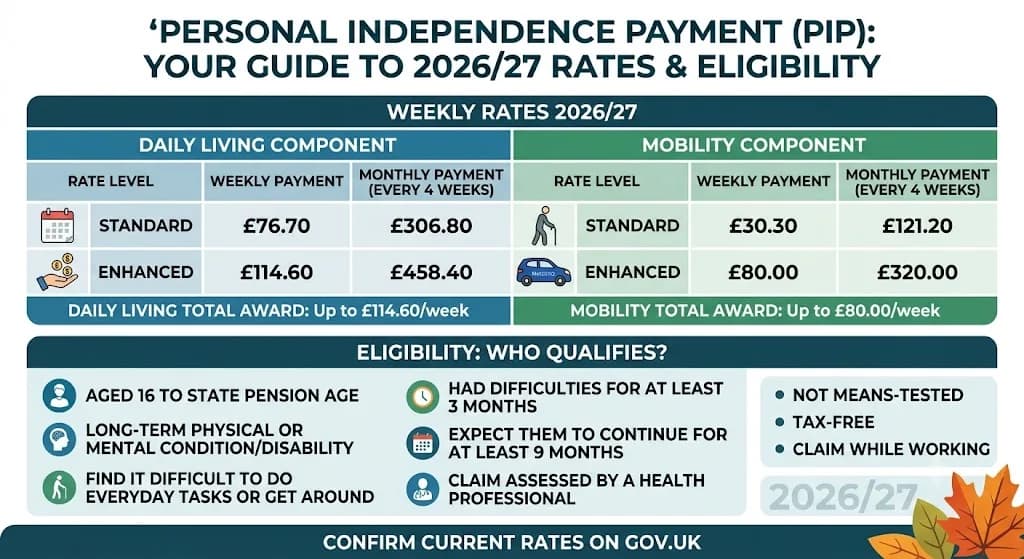
PIP has two components. You can be awarded one or both, each at either the standard or enhanced rate:
| Component | Standard rate | Enhanced rate |
|---|---|---|
| Daily living | Lower weekly rate | Higher weekly rate |
| Mobility | Lower weekly rate | Higher weekly rate |
Rates are reviewed each April. For the exact current weekly figures, always confirm on GOV.UK, as they are uprated annually. PIP is paid every four weeks.
Who is eligible for PIP?
You may qualify if all of the following apply:
- You’re aged 16 or over and under State Pension age when you first claim.
- You have a physical or mental health condition or disability.
- You’ve had difficulties with daily living and/or mobility for 3 months, and expect them to continue for at least 9 months (the “past and future” test).
- You’re usually resident in the UK and meet the residence conditions.
How the assessment works
Eligibility is decided by a points-based assessment, not your diagnosis. An assessor scores how your condition affects a set of everyday activities:
- Daily living activities: preparing and eating food, washing and dressing, managing medication and treatment, communicating, reading, managing money, and engaging with others.
- Mobility activities: planning and following a journey, and moving around.
You need 8 points for the standard rate of a component and 12 points for the enhanced rate. Because it’s about the help you need — aids, supervision, prompting or assistance — keeping a diary of your difficulties before assessment genuinely helps.
Is PIP taxable? Does it affect other benefits?
PIP is completely tax-free and doesn’t count as income for tax. Better still, receiving PIP can increase other support — it can unlock a disability premium or extra amount in Universal Credit, Carer’s Allowance for someone who looks after you, Council Tax reductions, and the Blue Badge and Motability schemes. It is never reduced by your earnings or savings.
See what else you might be entitled to alongside PIP:
PIP and work
You can work and claim PIP at the same time, full or part-time. Because PIP is about the extra costs of your condition rather than your ability to earn, your wages don’t reduce it. If you’re working, it’s worth checking your take-home pay separately so you see your full financial picture:
How to claim
- Start the claim by contacting the DWP to open a claim — they’ll take basic details and send a form.
- Complete the “How your disability affects you” form in detail, with real examples of difficult days.
- Send supporting evidence — letters, care plans, prescriptions — anything showing the help you need.
- Attend the assessment (often by phone or video) and describe your difficulties honestly, including how things vary.
- If refused, consider a mandatory reconsideration — many awards are won at this stage or on appeal.
The bottom line
PIP is a tax-free, non-means-tested payment worth claiming if a long-term condition affects your daily life or mobility — regardless of income, savings or work. Focus your claim on the help you need with specific activities, back it with evidence, and don’t give up at a first refusal. And once you have it, check whether it unlocks further support you’re missing.
Frequently asked questions
How much is PIP in 2026/27?
Is PIP taxable?
Who qualifies for PIP?
Can I work and claim PIP?
Does getting PIP increase other benefits?
Read next
More Benefits →
Benefits for Single Parents in the UK: What You Can Claim (2026)
A clear, compassionate guide to benefits for single parents in the UK - from Universal Credit and Child Benefit to free…

PIP Explained: Eligibility, Rates and How to Claim (2026)
A clear, compassionate guide to Personal Independence Payment (PIP): what it is, who qualifies, how the points-based…

Carer's Allowance and the earnings limit: how the overpayment trap works
Carer's Allowance has a cliff-edge earnings limit. Earn a penny over it in any week and you lose the entire payment for…
Rather someone else did it?
Partner linksFixed-fee services where a qualified accountant prepares and files your return.
TaxScouts
A real accountant files your return for one fixed fee.
Fixed fee, typically about £169 per return
Get my return doneGoSimpleTax
DIY Self Assessment software that checks for missed savings.
From about £54.99 per tax year
File it myselfWe may earn a commission if you sign up through one of these links. It never changes what we calculate, what we recommend, or the order they appear in.