News
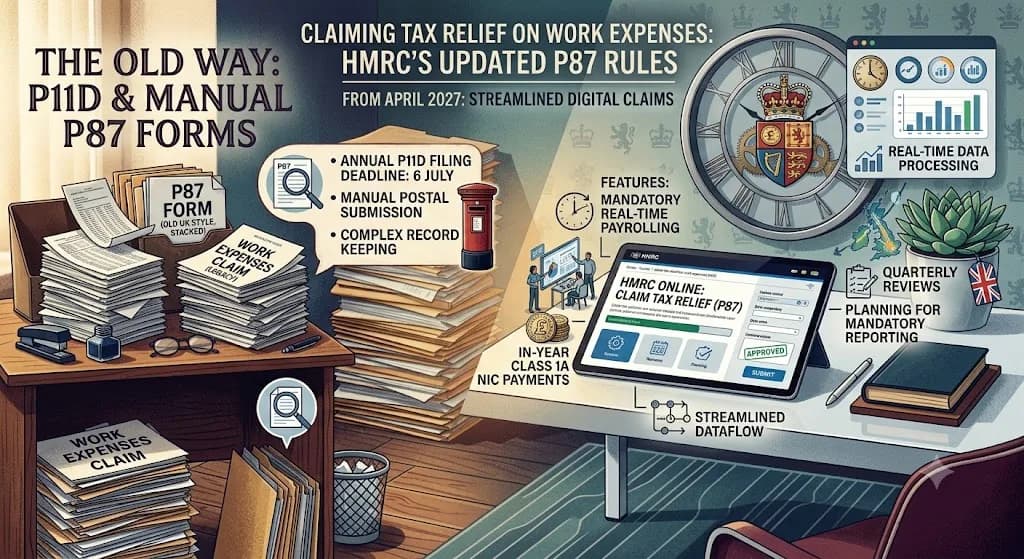
Claiming Tax Relief on Work Expenses: HMRC's Updated P87 Rules
HMRC has updated its P87 guidance and formal directions on what a job expenses claim must contain. Miss the employer…

Estimate the tax rebate you can claim for your work uniform, professional fees and unreimbursed mileage, and claim it free on form P87 instead of paying an agent 30%.
Tax relief on job expenses your employer didn't reimburse. Updates as you type.
Business mileage only, commuting to your normal workplace doesn't count.
years (you can back-claim up to 4)
Estimated tax rebate
per year × year(s)
Don't pay an agent 30%
A refund company would keep about of this. Claiming yourself on form P87 (or in your tax return) is free and you keep it all.
Estimate only. You must actually have incurred the costs; flat-rate amounts vary by job.
If you spend your own money on things you need for your job and your employer does not pay you back, you may be owed tax relief, and our uniform tax rebate calculator is built to show you roughly how much. The good news, which surprises a lot of people, is that claiming this money is free. You do not need to pay anyone a percentage of your refund, and HMRC will deal with you directly. This page explains what counts, the real figures for the 2026/27 tax year, and how to put a claim in without overpaying anyone.
Tax relief on employment expenses works by reducing the amount of your income that is taxed. If you are a basic rate taxpayer, every £100 of allowable expense gives you £20 back. A higher rate taxpayer gets £40 on the same £100. It is not a pound-for-pound refund of what you spent, it is a refund of the tax you paid on that part of your earnings. That distinction trips people up, so keep it in mind as you read on.
More employees qualify than realise it. You might have a claim if any of the following apply to you:
One important caveat up front. If you are self-employed, this relief does not apply to you in the same way, because you deduct expenses against your business profits instead. Have a look at our self-employed tax calculator or the self-employed tax guide for beginners if that is your situation. Everything on this page is aimed at people taxed under PAYE as employees.
HMRC sets standard flat-rate expense amounts for many jobs. These are fixed annual sums you can claim without keeping a single receipt, which is what makes them so easy. The general uniform allowance is £60 a year, but plenty of occupations have higher agreed figures because their clothing and equipment costs more to maintain.
Here are some of the common flat-rate figures for 2026/27:
| Occupation or expense | Annual flat-rate allowance (2026/27) | Refund at 20% | Refund at 40% |
|---|---|---|---|
| Standard uniform (most jobs) | £60 | £12 | £24 |
| Nurses and midwives (plus shoes and tights allowance) | £125 + £24 | £29.80 | £59.60 |
| Mechanics and vehicle technicians (some employers) | £120 | £24 | £48 |
| Joiners and carpenters | £140 | £28 | £56 |
| Electricians (electrical fitters) | £120 | £24 | £48 |
| Pilots and co-pilots (uniformed flight deck) | £1,022 | £204.40 | £408.80 |
The figures above are the most widely used amounts, but HMRC's full list is long and detailed by industry and even by employer, so the calculator picks the right one based on what you tell it. Where your trade has its own agreed flat rate, you use that instead of the £60 standard, not on top of it.
If you pay to belong to a professional body that is relevant to your job, and that body appears on HMRC's approved list (known as List 3), you can claim relief on the fee. Think nursing and midwifery registration, engineering institutions, accountancy bodies, the law societies, and many trade unions. You claim the actual amount you paid, so a £300 subscription is worth £60 to a basic rate taxpayer and £120 to someone paying higher rate. You cannot claim a fee your employer already pays for you, and you cannot claim life membership in one lump.
If your contract requires you to work from home, or there is genuinely no appropriate office for you to attend, you can claim tax relief on the extra household costs. HMRC's flat rate is £6 a week, which is worth around £62 a year of relief at the basic rate over a full year. You do not need to prove the exact cost when you use the flat rate. The catch most people miss is that choosing to work from home for convenience does not qualify, it has to be a requirement of the job. For a deeper look at the home working rules, our use of home as office calculator and the dedicated work expense tax rebate calculator walk through it, and HMRC sets out the conditions on its working at home page.
This is often the biggest part of a claim and the one most people overlook. When you drive your own vehicle for work (not your ordinary commute, but genuine business journeys), your employer can pay you tax free up to the Approved Mileage Allowance Payment (AMAP) rates. If they pay you less than the approved rate, or nothing, you can claim tax relief on the shortfall, which is called Mileage Allowance Relief.
| Vehicle | First 10,000 business miles | Each mile above 10,000 |
|---|---|---|
| Cars and vans | 45p per mile | 25p per mile |
| Motorcycles | 24p per mile | 24p per mile |
| Bicycles | 20p per mile | 20p per mile |
You compare the AMAP amount with what your employer actually paid you, and the difference is what you claim relief on. Our mileage allowance calculator handle the 10,000 mile threshold for you, and you can also check your overall position with the tax refund calculator or the cost per mile calculator.
Priya is a band 5 nurse paying tax at the basic rate of 20%. She washes her own uniform, pays £120 a year to keep her Nursing and Midwifery Council registration, and buys her own shoes and tights for shifts. For 2026/27 she can claim the nurses' uniform flat rate of £125, the shoes and tights allowance of £24, and her £120 professional fee. That totals £269 of allowable expenses. At 20%, her relief is around £53.80 for the year. Because she has never claimed before, she can also back-claim the previous four tax years, which lifts her one-off refund to roughly £215 plus the adjustment to her tax code going forward. None of this costs her a penny to claim.
Tom earns £58,000 and pays tax at 40% on the top slice of his income. He drove 12,000 business miles last year visiting clients, and his employer reimbursed him at 15p a mile. Using AMAP rates, his approved amount is 10,000 miles at 45p (£4,500) plus 2,000 miles at 25p (£500), giving £5,000. His employer paid him 12,000 miles at 15p, which is £1,800. The shortfall of £3,200 is his allowable expense. At 40%, that is worth £1,280 back to Tom for a single year. Because he is a higher earner, he should also keep an eye on how reliefs interact with thresholds, and the 60% tax trap calculator is worth a look if his income sits near £100,000.
You can claim in two ways, both free.
Now the part I feel strongly about as an adviser. You will see adverts from refund agents promising to get your money back. Many of them keep 25% to 30% of your refund, sometimes more, plus a fee, and a few have used assignment clauses that funnel future refunds to them too. There is nothing they do that you cannot do yourself in about fifteen minutes. HMRC deals with employees directly and for free. If you have already signed up with one and regret it, contact HMRC, who can tell you what is on file.
You are not limited to the current year. You can back-claim for the four previous tax years, so a first-time claim in 2026/27 can reach back to 2022/23. That is why a modest annual allowance can produce a refund several times larger the first time round. Once your claim is processed, HMRC usually adjusts your tax code so you get the relief automatically each year, although it is sensible to check the code is right. Our tax code calculator and the tax codes explained guide help you read it.
Tell the calculator your occupation or the type of expense, your business mileage and what your employer paid, any professional fees, and whether you work from home under your contract. It applies the right 2026/27 flat rates and AMAP figures, works out the relief at your tax rate, and estimates your back-claim across earlier years. Treat the result as a well-informed estimate to take into your P87 or Self Assessment return, not a formal HMRC calculation.
While you are here, it is often worth understanding your wider tax picture. The income tax calculator, the take-home pay calculator and our overview of UK income tax rates and bands for 2026/27 all help you see how a rebate fits into your overall position. If you suspect you have overpaid more generally, check if HMRC owes you money is a sensible next step.
Gather what you spent, run the numbers through the uniform tax rebate calculator, and then claim free using form P87 or your Self Assessment return. If your circumstances are complicated, for example you have multiple employers or large expenses, a short conversation with an accountant can pay for itself. Either way, do not hand a third of your money to a refund agent for a job you can do yourself.
Disclaimer: the figures here are for the 2026/27 UK tax year and are intended as general guidance. Tax depends on your personal circumstances and the rules can change. Please check your own position with HMRC or a qualified accountant before you rely on any number.
Employees can claim tax relief on costs incurred for work that the employer has not reimbursed — uniform laundering, tools, professional subscriptions, and working from home. Many occupations have a flat-rate expense agreed with HMRC, so you can claim without keeping receipts.
The point people miss is that you get back your marginal tax rate of the expense, not the expense itself. A £120 flat rate returns £24 to a basic-rate taxpayer. Modest — but claims can be backdated four years, and the relief usually continues automatically in your tax code once granted.
HMRC has updated its P87 guidance and formal directions on what a job expenses claim must contain. Miss the employer…
Employees can no longer claim working from home tax relief - it was withdrawn from 6 April 2026. You can still claim…
You can normally take 25% of your pension as a tax-free lump sum, capped at £268,275. Here is exactly how the rule works…
If you keep your own books, these are the packages that handle Self Assessment and Making Tax Digital.
The freelancer and contractor favourite, free with some bank accounts.
From £0 with a NatWest, RBS or Mettle account, otherwise about £19/mo
See FreeAgentThe big all-rounder with the deepest MTD track record.
From about £10/mo, frequent 90% off intro offers
See QuickBooksThe scale-up choice once you have staff, stock or VAT.
From about £15/mo
See XeroWe may earn a commission if you sign up through one of these links. It never changes what we calculate, what we recommend, or the order they appear in.