

Contents
- At a glance
- Method 1: the simplified flat rate
- Method 2: actual costs
- Calculator: Mileage Allowance Calculator
- Where the break-even sits
- The rule that catches people: you cannot switch
- Which journeys count as business mileage?
- Electric vehicles and the flat rate
- If you use more than one vehicle
- What records you actually need
- A note on how to use this
- Where these figures come from
If you are self-employed and use a vehicle for work, you can claim the cost against your profits. There are two methods, they produce very different numbers, and the choice is effectively permanent for each vehicle — so it is worth understanding both before you make your first claim.
This guide covers the flat rate, the actual cost method, where the break-even sits, and the traps that catch people out. If you are an employee rather than self-employed, the rules are different and our HMRC mileage rate guide covers your position.
At a glance
| First 10,000 business miles | 55p per mile |
| Miles above 10,000 | 25p per mile |
| Motorcycles | 24p per mile |
| Flat rate covers | Fuel, insurance, tax, servicing, depreciation |
| Can also claim | Business parking and tolls |
| Switching method | Locked per vehicle |
| Records required | Contemporaneous mileage log |
Method 1: the simplified flat rate
Under simplified expenses you claim a fixed amount per business mile and forget about the vehicle's actual costs entirely:
| Vehicle and mileage | Rate per mile |
|---|---|
| Cars and vans, first 10,000 business miles | 55p |
| Cars and vans, each mile after 10,000 | 25p |
| Motorcycles, all miles | 24p |
The rate covers everything to do with running the vehicle: fuel, insurance, road tax, servicing, repairs, MOT and depreciation. You cannot claim any of those separately on top, and you cannot claim capital allowances on the vehicle.
What you can still claim alongside are costs that are not vehicle running costs at all — business parking, and tolls or congestion charges incurred on a business journey. Parking fines are never allowable, however unfairly issued.
Worked example
Rachel drives 12,000 business miles a year as a self-employed consultant. Her claim is 10,000 at 55p (£5,500) plus 2,000 at 25p (£500), giving £6,000. She keeps a mileage log and nothing else.
At 20% income tax plus 6% Class 4 National Insurance, that deduction saves her around £1,560 in tax and NI — for the administrative cost of recording her journeys.
Method 2: actual costs
The alternative is to claim the genuine business proportion of what the vehicle actually costs you, plus capital allowances on the vehicle itself.
You total every running cost for the year — fuel, insurance, road tax, servicing, repairs, MOT, breakdown cover, cleaning — and apply your business-use percentage. If 70% of your mileage is business, you claim 70% of the total.
On top of that you claim capital allowances on the purchase cost of the vehicle, again restricted to the business proportion. For cars the rate depends on CO₂ emissions, with the most efficient vehicles attracting the fastest relief and higher-emission cars written down slowly. Vans are treated more generously than cars and usually qualify for the annual investment allowance, meaning the full cost in the year of purchase.
Worked example: the same driver, different method
Rachel's actual costs are £4,200 a year and 80% of her mileage is business, giving £3,360. Her car cost £24,000, and capital allowances on the business proportion add perhaps £1,500 in the first year depending on emissions.
Her total claim is around £4,860 — noticeably less than the £6,000 the flat rate produced, and requiring her to keep every receipt for the year plus a full mileage log to evidence the 80%.
For Rachel, the flat rate wins on both money and effort. That is the usual outcome for an ordinary car doing reasonable mileage.
Work it out for your own figures
Open the full Mileage Allowance Calculator →Your business mileage
Work out the tax-free mileage allowance you can claim under HMRC's Approved Mileage Allowance Payments (AMAP).
Miles carrying colleagues on business - worth an extra 5p each.
Leave at 0 if your employer pays nothing. We compare it against the AMAP rate.
Used to estimate the tax relief on any shortfall (Mileage Allowance Relief).
AMAP rates: cars/vans for the first miles then ; motorcycles ; bicycles per mile.
Tax-free allowance you can claim
for business miles by
- First miles @
- miles @
- passenger miles @ 5p
- miles @
- Total allowance
Your employer underpays the AMAP rate
unclaimed shortfall
tax relief you can claim
Claim Mileage Allowance Relief on the difference via your tax return or a P87.
Your employer meets or exceeds the AMAP rate
Anything above the AMAP rate () is taxable and should appear on form P11D.
Estimate only. AMAP covers fuel, insurance, servicing and depreciation.
Allowance across the mileage range
claimNotice the line gets shallower past miles, where the rate drops from to .
Compare saved scenarios
| Scenario | Miles | Allowance | Relief | |
|---|---|---|---|---|
Where the break-even sits
As a rule of thumb, the flat rate wins for most people with an ordinary car, and the actual cost method wins in three situations:
- An expensive vehicle. The flat rate makes no distinction between a ten-year-old hatchback and a new £60,000 car. Capital allowances on the latter can dwarf a mileage claim.
- Low business mileage in a costly vehicle. Someone driving 2,000 business miles claims £1,100 on the flat rate. If the vehicle genuinely costs a great deal to run, the proportionate actual claim can be higher.
- A van used almost entirely for business. High business-use percentage plus the annual investment allowance on the purchase is a powerful combination that the flat rate cannot match.
Conversely the flat rate is almost always right for high-mileage drivers in modest vehicles, and for anyone who does not want to keep a year's worth of receipts. Compare both on your own numbers with the Mileage Allowance Calculator.
The rule that catches people: you cannot switch
Once you claim the flat rate for a particular vehicle, you must continue using it for that vehicle for as long as you use it in the business. You cannot take the flat rate in a good mileage year and actual costs in a year when the gearbox fails.
The lock is per vehicle, not per business, which gives you one genuine opportunity: when you change vehicles, you choose again. If you bought an expensive car for a business doing modest mileage, that is the moment to move to actual costs.
There is one absolute restriction. If you have already claimed capital allowances on a vehicle, you cannot then switch to the flat rate for it. The two systems cannot be mixed on the same asset.
Which journeys count as business mileage?
This is where most claims go wrong, and where HMRC enquiries concentrate.
Allowable: travel to a client or customer, to a temporary workplace, between two workplaces, to buy business supplies, and to a business meeting or training course.
Not allowable: ordinary commuting between home and a permanent workplace. If you work from home and home is your business base, journeys from home to a client are business travel — but if you have a separate business premises, home to premises is commuting and does not count.
A journey with both business and private purpose needs apportioning, and you can only claim the business element. Detouring to a client on the way to a holiday does not make the whole trip deductible.
Electric vehicles and the flat rate
The simplified mileage rates apply to electric vehicles exactly as they do to petrol and diesel, which produces a quietly favourable outcome for EV drivers.
The rate is set to reflect the average cost of running a car, but charging at home is typically far cheaper per mile than filling a tank. An EV driver claiming 55p a mile is very often claiming considerably more than the journey actually cost them — entirely legitimately, because the flat rate is a fixed statutory amount rather than a reimbursement of proven spend.
The counter-argument is capital allowances. Fully electric cars have historically attracted more generous first-year relief than petrol equivalents, which can make the actual cost method attractive for a newly purchased EV. As always the answer depends on the purchase price against the annual mileage, so it is worth running both before committing the vehicle to one method.
If you use more than one vehicle
The method choice is made per vehicle, so a business running a van and a car can legitimately use the flat rate for one and actual costs for the other. That is not a loophole; it is how the rule is designed, and for many sole traders it is the optimal position.
A common pattern is actual costs on a van that is used almost exclusively for the business and attracts the annual investment allowance, alongside the flat rate on a personal car used occasionally for client visits. Each vehicle is assessed on its own facts, and each keeps its own method for as long as it is in the business.
What you cannot do is claim both methods for the same vehicle in the same year, or move a vehicle between methods because circumstances changed. Keep a clear record of which method applies to which vehicle, particularly if you change cars part way through a tax year and the business has two cars in the accounts for that period.
What records you actually need
Whichever method you use, you must keep a mileage log. HMRC will ask for it, and a reconstructed log written a year later is not persuasive.
For each business journey record the date, the start and end points, the purpose, and the miles. A phone app that logs journeys automatically is the simplest approach; a notebook in the glovebox works just as well provided it is contemporaneous.
If you use the actual cost method you additionally need every receipt for the year, plus enough mileage data to justify your business-use percentage. That is a materially heavier burden, and it is a real part of the comparison rather than a footnote to it.
Once you have your figure, feed it into your Self Assessment return alongside your other expenses — our Self-Employed Tax Calculator shows the effect on your bill, and payments on account explains why January's demand may be larger than you expect.
A note on how to use this
This guide explains the rules as they stand for the 2026/27 tax year and is written to help you understand your own position. It is general information, not personal financial advice — your circumstances change the answer, sometimes completely. For a decision that matters, speak to a regulated adviser or check directly with HMRC. Our calculation methodology sets out where every figure on this site comes from.
Where these figures come from
Every rate and threshold on this page is checked against HMRC's published guidance for the 2026/27 tax year. If you spot a figure that looks out of date, please tell us.
Frequently asked questions
What is the self-employed mileage rate?
Can I claim fuel as well as the mileage rate?
Is the flat rate or actual costs better?
Can I switch between the mileage rate and actual costs?
Does commuting count as business mileage?
What records do I need for a mileage claim?
Read next
More Business Finance →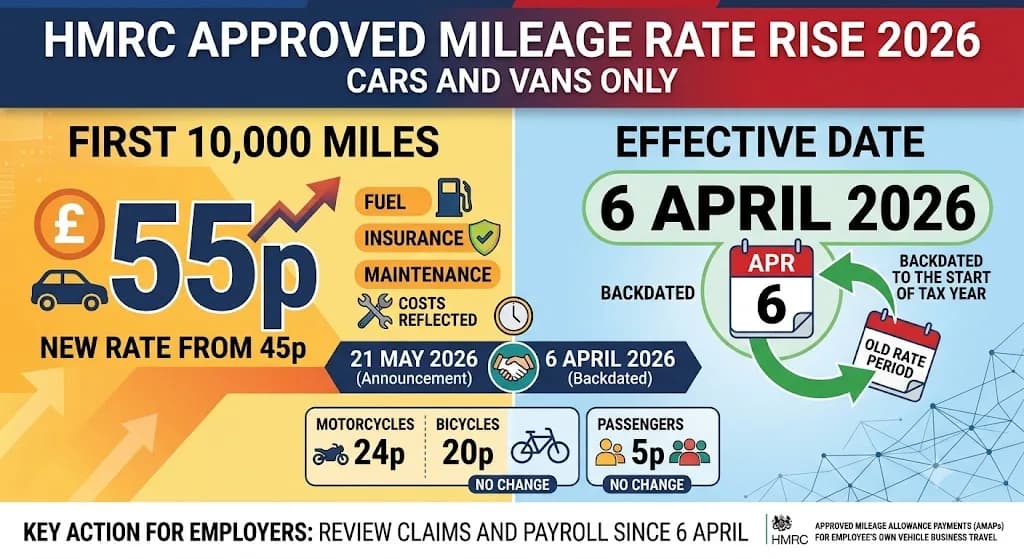
HMRC Mileage Rate Rises to 55p a Mile, Backdated to 6 April 2026
The approved mileage rate for cars and vans rises from 45p to 55p per mile for the first 10,000 business miles, the…

Salary vs Dividends: How Should a Director Pay Themselves in 2026/27?
Most company directors pay themselves with a small salary plus dividends. Here's how the split works in 2026/27, and how…

Self-Employed Tax: A Beginner's Guide (2026/27)
Just gone self-employed? Here's everything you need to know about tax - what you'll pay, when, how to register, what you…
Rather someone else did it?
Partner linksFixed-fee services where a qualified accountant prepares and files your return.
TaxScouts
A real accountant files your return for one fixed fee.
Fixed fee, typically about £169 per return
Get my return doneGoSimpleTax
DIY Self Assessment software that checks for missed savings.
From about £54.99 per tax year
File it myselfWe may earn a commission if you sign up through one of these links. It never changes what we calculate, what we recommend, or the order they appear in.