
Contents
- Quick answer
- Key facts at a glance
- What payrolling a benefit actually means
- Calculator: Company Car Tax Calculator
- The timetable in full
- Example 1: the company car driver
- Example 2: the employer with private medical cover
- What employers should do before April 2027
- What it means for employees
- Common mistakes to avoid
- Sources
Quick answer
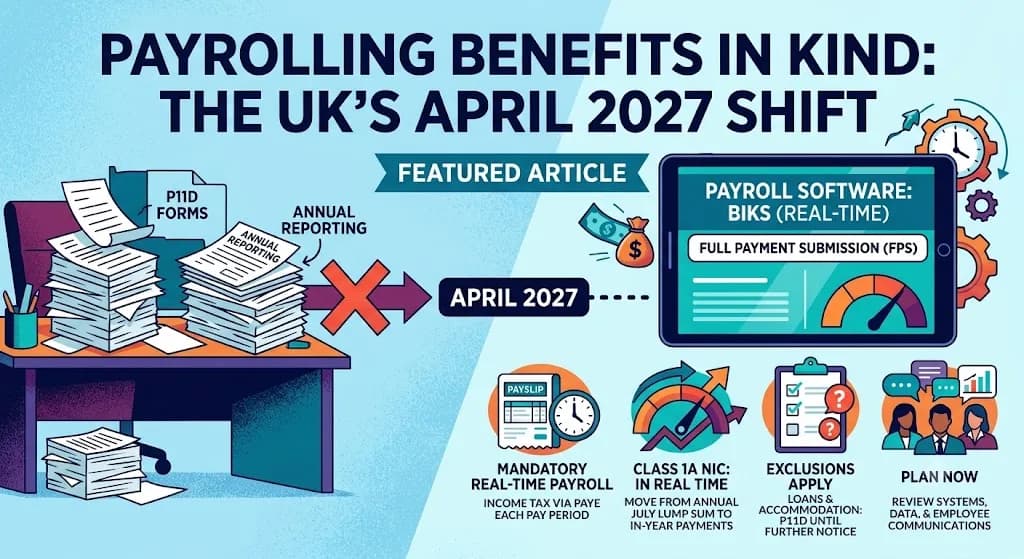
From 6 April 2027, employers must report and tax company cars, car fuel, vans, van fuel and employer-provided medical benefits through the payroll in real time, instead of on an annual P11D. Most other benefits in kind follow from April 2028. Employment-related loans and living accommodation stay outside the mandatory rules and can still be payrolled voluntarily or reported on a P11D. HMRC confirmed this two-phase timetable on 15 June 2026, after delaying the original April 2026 start date.
Key facts at a glance
| Question | Answer |
|---|---|
| What is changing | Benefits in kind move from annual P11D reporting into real-time payroll (the Full Payment Submission) |
| Phase 1 start | 6 April 2027: company cars, car fuel, vans, van fuel, medical benefits |
| Phase 2 start | April 2028: most remaining benefits in kind |
| Always excluded from mandation | Employment-related loans and living accommodation (voluntary payrolling allowed) |
| Last normal P11D year | 2026/27, filed by 6 July 2027 |
| Who announced it | HMRC, 15 June 2026 (originally planned for April 2026) |
What payrolling a benefit actually means
Today, most benefits in kind are reported once a year on form P11D. HMRC then adjusts the employee's tax code so the tax trickles in during the following year, always one step behind reality. Payrolling replaces that loop: the cash value of the benefit is divided across the year's pay periods and added to taxable pay each payday, so the tax is collected in the same year the benefit is enjoyed.
Here is how the process changes for a payrolled benefit:
- The employer works out the cash equivalent of the benefit for the year, exactly as now.
- That value is split across the number of paydays (12 for monthly payroll).
- Each payday, the slice is added to taxable pay for PAYE purposes only. The employee does not receive extra money; they just pay tax on the benefit as they go.
- The benefit is reported to HMRC on the Full Payment Submission (FPS), the same real-time report employers already send every payday.
- No P11D is needed for that benefit, and no tax-code adjustment chases the employee into the following year.
Work it out for your own figures
Open the full Company Car Tax Calculator →Your company car
List price incl. VAT and most options, less any one-off capital contribution.
HMRC sets a fixed figure each year (check the current car fuel benefit charge on gov.uk). The fuel benefit = this figure × your BIK %.
Your employer pays Class 1A NI on the total benefit. Confirm the current rate on gov.uk.
Annual company car tax
per month from your pay
- Taxable benefit (BIK)
- Fuel benefit
- Total benefit in kind
- Tax on car
- Tax on fuel
- Your tax - per month
Cost to your employer
Class 1A NI per year on the total benefit (in addition to your own tax).
Estimate only. The BIK % depends on the car's CO₂ emissions - electric cars are very low. Check your band on gov.uk.
Annual tax across CO₂ bands
How your annual tax changes as the BIK percentage rises - a low-emission or electric car can sit at the far left, a high-emission car at the right.
Based on a P11D of at . Your current band is highlighted in the table below.
| BIK % | Taxable benefit | Annual tax | Per month |
|---|---|---|---|
What your Company Car Tax Calculator result means
The Company Car Tax Calculator does more than show a number. Below your result it explains what your figures mean in practice - your effective and marginal rates, any allowances or thresholds you are close to, and the specific steps to take next. Enter your details above and the guidance updates to match your situation.
Do this next, in order
Estimates only - not financial or tax advice. Confirm figures on GOV.UK or with an adviser.
Compare saved cars
| Car | P11D | BIK | Annual tax | Per month | |
|---|---|---|---|---|---|
The timetable in full
| Tax year | What applies |
|---|---|
| 2026/27 (now) | Current rules. P11Ds due by 6 July 2027. Voluntary payrolling available if you registered with HMRC before 6 April 2026. |
| 2027/28 | Phase 1 mandatory: company cars, car fuel, vans, van fuel and medical benefits must go through payroll. Other benefits stay on P11D (or voluntary payrolling). |
| 2028/29 | Phase 2: most remaining benefits in kind become mandatory through payroll. P11Ds survive only for loans and accommodation where these are not voluntarily payrolled. |
Example 1: the company car driver
Amira has a company car with a cash equivalent of £6,000 a year and pays higher-rate tax at 40%, so the car costs her £2,400 in tax annually.
| Now (P11D and tax code) | From April 2027 (payrolled) | |
|---|---|---|
| How the £6,000 is reported | P11D after year end | £500 added to taxable pay each month via FPS |
| How the £2,400 tax is collected | Tax code reduced the following year | £200 extra PAYE each month, in real time |
| Risk of surprise bills | Yes, when the code lags a car change | Minimal: tax tracks the benefit month by month |
Her payslip's taxable gross rises by £500 a month but her cash pay does not change; only the tax deduction does. Check what a car costs you with our Company Car Tax Calculator.
Example 2: the employer with private medical cover
A design agency provides private medical insurance costing £1,200 a year to each of its 15 staff. From April 2027 the agency must put £100 a month per employee through payroll as a taxable benefit instead of filing 15 P11Ds the following July. Employer Class 1A National Insurance at 15% still applies, costing £180 per employee per year, and moves to real-time reporting alongside the benefit. The agency saves the July P11D scramble, but its payroll software and processes must be ready before the first April 2027 payday. Our P11D Generator stays useful for the 2026/27 filings and, after that, for loans and accommodation.
What employers should do before April 2027
- Audit your benefits now. List every benefit you provide and tag which phase it falls into.
- Ask your payroll software provider when payrolling and real-time Class 1A support will be ready.
- Consider voluntary payrolling early. Registering ahead of a tax year lets you move before you are forced to, one benefit type at a time.
- Budget for the cash-flow shift on Class 1A, which moves from an annual payment to real time for payrolled benefits.
- Tell your employees what is coming. Their payslips will show higher taxable pay and their tax codes will be rebuilt to remove benefit deductions; without warning, that reads as a pay cut.
What it means for employees
You will not pay more tax overall; you will pay the same tax sooner and more accurately. The main transition risk is 2027/28 itself: if your tax code still carries a benefit deduction while your employer starts payrolling the same benefit, you would briefly pay tax twice. HMRC and employers are expected to strip benefit adjustments out of codes as payrolling starts, but it is worth checking your own. Our tax code guides explain every letter and number, and the Income Tax Calculator shows what your take-home should look like.
Common mistakes to avoid
- Treating April 2027 as a soft deadline. Phase 1 is mandatory. If you run payroll for anyone with a company car, van or medical cover, your first 2027/28 payday must handle it.
- Forgetting 2026/27 P11Ds. The old regime runs fully until 6 July 2027. Payrolling from April 2027 does not cancel the P11Ds due for the year before.
- Assuming everything is phase 1. Gym memberships, professional subscriptions and most other benefits stay on the old rules until April 2028.
- Employees ignoring their tax code in 2027. Check that benefit deductions disappear from your code once your employer starts payrolling.
Frequently asked questions
When does mandatory payrolling of benefits start?
Will P11Ds be abolished?
Will employees pay more tax on their benefits?
Does payrolling change what appears on a payslip?
What happens to employer Class 1A National Insurance?
Can employers start payrolling benefits before 2027?
Read next
More Business Finance →
Company Car Tax on Electric Cars 2026/27: BiK Rates to 2030
Electric company cars are taxed on 4% of list price in 2026/27, rising to 5%, 7% and 9% by 2029/30. Here are the full…

Salary vs Dividends: How Should a Director Pay Themselves in 2026/27?
Most company directors pay themselves with a small salary plus dividends. Here's how the split works in 2026/27, and how…

Self-Employed Tax: A Beginner's Guide (2026/27)
Just gone self-employed? Here's everything you need to know about tax - what you'll pay, when, how to register, what you…
Rather someone else did it?
Partner linksFixed-fee services where a qualified accountant prepares and files your return.
TaxScouts
A real accountant files your return for one fixed fee.
Fixed fee, typically about £169 per return
Get my return doneGoSimpleTax
DIY Self Assessment software that checks for missed savings.
From about £54.99 per tax year
File it myselfWe may earn a commission if you sign up through one of these links. It never changes what we calculate, what we recommend, or the order they appear in.