Business Finance
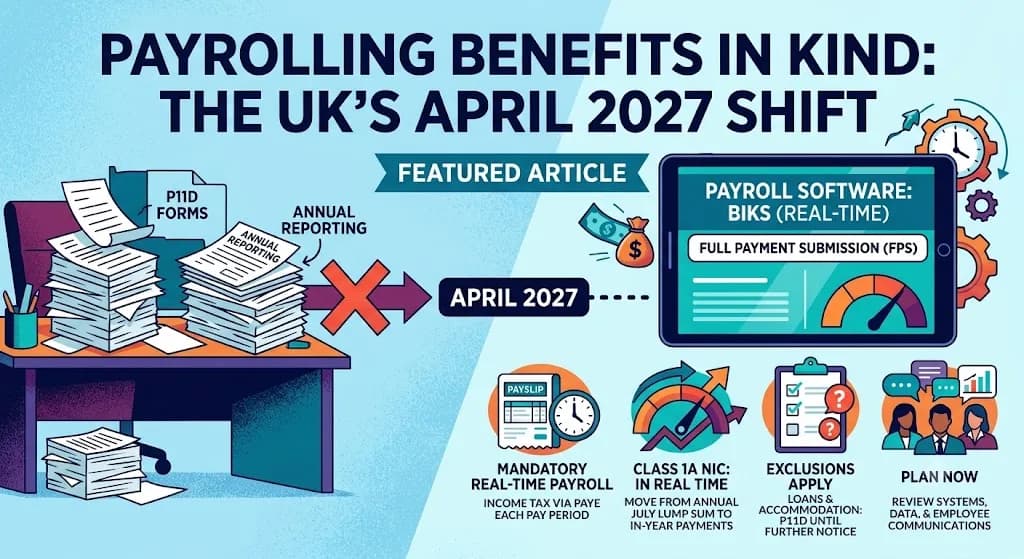
Payrolling Benefits in Kind: What Changes from April 2027
HMRC has confirmed that company cars, fuel and medical benefits must be taxed through payroll from 6 April 2027, with…

This company car tax calculator works out the Benefit-in-Kind (BIK) you pay on a car your employer provides, for the 2026/27 tax year. Tell it the car's P11D value and its appropriate percentage and you'll see the taxable benefit, the income tax due, and roughly what it costs you each month.
It's built for employees offered a company car or weighing one up against a cash allowance, and for company directors deciding what to put through the business. The numbers below explain exactly how the figure is reached, so you're not taking the result on trust.
List price incl. VAT and most options, less any one-off capital contribution.
HMRC sets a fixed figure each year (check the current car fuel benefit charge on gov.uk). The fuel benefit = this figure × your BIK %.
Your employer pays Class 1A NI on the total benefit. Confirm the current rate on gov.uk.
Annual company car tax
per month from your pay
Cost to your employer
Class 1A NI per year on the total benefit (in addition to your own tax).
Estimate only. The BIK % depends on the car's CO₂ emissions - electric cars are very low. Check your band on gov.uk.
How your annual tax changes as the BIK percentage rises - a low-emission or electric car can sit at the far left, a high-emission car at the right.
Based on a P11D of at . Your current band is highlighted in the table below.
| BIK % | Taxable benefit | Annual tax | Per month |
|---|---|---|---|
The Company Car Tax Calculator does more than show a number. Below your result it explains what your figures mean in practice - your effective and marginal rates, any allowances or thresholds you are close to, and the specific steps to take next. Enter your details above and the guidance updates to match your situation.
Do this next, in order
Estimates only - not financial or tax advice. Confirm figures on GOV.UK or with an adviser.
| Car | P11D | BIK | Annual tax | Per month | |
|---|---|---|---|---|---|
Enter the car's P11D value, its appropriate percentage (driven by CO2 emissions and, for electric and hybrid cars, the electric range) and your income tax rate. The tool above returns your annual taxable benefit and the tax you'll pay. Read on to see how each part of that sum works, with worked examples you can check against your own car.
A company car you can use privately is a taxable perk, so HMRC taxes it as a Benefit-in-Kind. You don't pay tax on the car's full price. Instead you pay income tax on a slice of its value each year, and the size of that slice depends on how polluting the car is.
The formula has two steps. First, find the taxable benefit:
Taxable benefit (BIK) = P11D value × appropriate percentage
Then turn that benefit into tax using your own marginal income tax rate:
Company car tax = taxable benefit × your income tax rate
The P11D value is the car's list price including VAT, delivery and most factory options, plus accessories — not the discounted price your employer actually paid. The appropriate percentage is set by HMRC from the car's CO2 emissions; the cleaner the car, the lower the percentage, with fully electric cars sitting far below petrol and diesel models. You can look up the exact percentage for your car's CO2 figure on the gov.uk company car tax guidance; the calculator and examples here apply whichever percentage you enter.
The tax itself follows the normal income tax bands. A basic-rate employee pays 20% on the benefit, a higher-rate employee 40%, and an additional-rate employee 45%. The benefit sits on top of your salary, so if it pushes part of your income into the next band, that part is taxed at the higher rate. To see where your salary leaves you before the car is added, run your figures through our income tax calculator.
Two extra points matter. If your employer also pays for private fuel, there's a separate fuel benefit charge on top — often poor value unless you do heavy private mileage. And National Insurance: you don't pay employee NI on the car benefit, but your employer pays Class 1A NI on it, which is why some firms restrict their car lists.
Priya is a project manager earning £60,000, so she's a higher-rate taxpayer. Her company car has a P11D value of £30,000. She looks up the CO2 figure and the appropriate percentage for her car is 29% (use your own car's figure here).
If Priya were a basic-rate taxpayer instead, the same £8,700 benefit would cost £8,700 × 20% = £1,740 a year (£145 a month). Same car, very different bill — which is why your tax rate matters as much as the car.
Tom is offered an electric car with a P11D value of £40,000 and a low appropriate percentage of 3% (again, confirm your car's exact figure on gov.uk). He's a higher-rate taxpayer.
A more expensive car, yet roughly one-seventh of Priya's tax bill. That gap is the whole reason electric company cars and salary sacrifice car schemes have become so popular — the low BIK on EVs makes them cheap to run as a benefit. If you want to estimate the running cost too, the EV charging cost calculator covers the electricity side.
Scotland sets its own income tax bands. Take Priya's £8,700 benefit again, but assume she lives in Scotland and the benefit falls in the Scottish higher rate of 42%:
That's £174 more than the £3,480 an equivalent driver pays in England, Wales or Northern Ireland — because Scottish income tax rates are higher in the middle bands. A Scottish advanced-rate driver would pay 45% on the benefit. Check your position with the Scotland tax calculator if you're north of the border.
The benefit itself comes from your car's P11D value and appropriate percentage. The tax on that benefit uses these income tax rates for 2026/27 (England, Wales and Northern Ireland), confirmed against gov.uk:
| Band | Taxable income | Rate applied to the car benefit |
|---|---|---|
| Personal Allowance | Up to £12,570 | 0% |
| Basic rate | £12,571 – £50,270 | 20% |
| Higher rate | £50,271 – £125,140 | 40% |
| Additional rate | Over £125,140 | 45% |
Scotland uses different bands — the relevant company car rates there are typically 21%, 42%, 45% or 48% depending on your total income. Source: gov.uk income tax rates. Always confirm your car's appropriate percentage on the gov.uk company car tax rules before relying on a figure.
For wider context on how perks and benefits are taxed, MoneyHelper's free guidance is a useful, impartial starting point.
These figures are estimates for guidance only and not personal tax or financial advice. Confirm your car's appropriate percentage and your tax position with gov.uk or a qualified adviser before making a decision.
A company car is taxed as a benefit in kind, not as a car. The charge is based on the vehicle’s list price multiplied by a percentage set by its CO₂ emissions, and you then pay Income Tax on that figure at your marginal rate. That is why an expensive low-emission car can cost less in tax than a cheaper polluting one.
The gap between electric and petrol is the headline: electric vehicles attract a very low benefit percentage, which is what makes salary-sacrifice EV schemes so attractive. If your employer offers one, the salary sacrifice calculator shows the other half of that arrangement.
Plan the whole picture with our take-home pay calculator, weigh a car scheme against your pay with the salary sacrifice calculator, and if you're a director comparing reward routes, try the dividend vs salary calculator.
HMRC has confirmed that company cars, fuel and medical benefits must be taxed through payroll from 6 April 2027, with…
You can normally take 25% of your pension as a tax-free lump sum, capped at £268,275. Here is exactly how the rule works…
Understand UK income tax rates and bands for 2026/27, including the Personal Allowance, the basic, higher and additional…
If you keep your own books, these are the packages that handle Self Assessment and Making Tax Digital.
The freelancer and contractor favourite, free with some bank accounts.
From £0 with a NatWest, RBS or Mettle account, otherwise about £19/mo
See FreeAgentThe big all-rounder with the deepest MTD track record.
From about £10/mo, frequent 90% off intro offers
See QuickBooksThe scale-up choice once you have staff, stock or VAT.
From about £15/mo
See XeroWe may earn a commission if you sign up through one of these links. It never changes what we calculate, what we recommend, or the order they appear in.