

Contents
- At a glance
- Employees: the relief was withdrawn from 6 April 2026
- The self-employed: a much easier route
- Calculator: Work Uniform & Expense Tax Rebate Calculator
- What if your employer pays you instead?
- Equipment, furniture and broadband
- Does claiming affect capital gains tax on your home?
- Common mistakes
- A note on how to use this
- Where these figures come from
Employees can no longer claim working from home tax relief. GOV.UK is explicit: from the tax year 6 April 2026 to 5 April 2027, you cannot claim it. There is no eligibility test to pass any more, because there is no relief left to claim.
Two things still matter, and they are why this guide exists. You can still claim for the four previous tax years, which is worth around £250 to a basic-rate taxpayer who never got round to it. And if you are self-employed the withdrawal does not touch you — your home-working costs are a business expense under different rules, and those rules are unchanged.
At a glance
| Employees, 2026/27 | Cannot claim — withdrawn from 6 April 2026 |
| Employees, four earlier years | Still claimable at £6 a week |
| Self-employed: 25–50 hrs/month | £10 a month |
| Self-employed: 51–100 hrs/month | £18 a month |
| Self-employed: 101+ hrs/month | £26 a month |
| Actual cost method | Apportion by rooms and time |
| Backdating deadline | 4 years from the end of the tax year |
Employees: the relief was withdrawn from 6 April 2026
This is not a tightening of the rules. The relief has gone. GOV.UK puts it in one line: “From the tax year 6 April 2026 to 5 April 2027, you will not be able to claim tax relief for working from home.”
There is nothing left to qualify for in the current year. It makes no difference whether your contract requires home working, whether your employer has an office, or how far you live from it. For 2026/27 there is no employee deduction for household costs, for anyone.
Two related things are unaffected, and people run all three together. If your employer pays you a homeworking allowance, that is a separate rule about what an employer may reimburse tax-free, and it still stands. And if you are self-employed, none of this applies to you — see the next section.
The four years you can still claim
You can claim for the current tax year and the four previous ones. With 2026/27 now closed to employees, four claimable years remain, and a claim must reach HMRC within four years of the end of the tax year it relates to. They fall away one at a time:
| Tax year | Flat rate claimable | Claim by |
|---|---|---|
| 2022/23 | £6 a week | 5 April 2027 |
| 2023/24 | £6 a week | 5 April 2028 |
| 2024/25 | £6 a week | 5 April 2029 |
| 2025/26 | £6 a week | 5 April 2030 |
For those years the old test still governs the claim: you had to be required to work from home, not merely allowed to. That meant your employer had no premises you could use, or your contract required home working with no alternative workspace, or the job placed you too far from any office to travel. Hybrid working by choice did not qualify then, and the withdrawal does not make it claimable now.
What the claim is actually worth
The number people misread is the £6. You do not receive £6 a week. You receive the tax on it, at your marginal rate.
Worked example — Daniel, basic-rate taxpayer. Daniel was contractually home-based for the whole of 2024/25 and never claimed. He claims the flat rate: £6 × 52 = £312 of allowable expenses. At 20% that is £62.40 back for the year. He also qualified in 2022/23, 2023/24 and 2025/26, so claiming all four years returns roughly £249.60.
Worked example — Priya, higher-rate taxpayer. The same £312 a year, but Priya pays 40%, so each year is worth £124.80 and four years come to about £499.20. If her actual additional costs were demonstrably higher than £6 a week she could claim those instead, but she would need bills showing the increase attributable to working, which is why almost everyone takes the flat rate.
Claims go on your Self Assessment return if you file one, or on form P87 if you do not. HMRC tightened the P87 process: claims now need supporting evidence, your employer’s PAYE reference, and your industry where flat rate expenses are involved, and incomplete claims are rejected outright rather than queried. Our guide to P87 work expense claim rules covers it step by step, and the work expense tax rebate calculator will total a multi-year claim for you.
The self-employed: a much easier route
If you are self-employed, none of the above applies. You are running a business from home, and the cost of doing so is a business expense. There is no "requirement" test to pass.
You have two methods, and you can pick whichever produces the better result.
Method 1: simplified expenses (flat rate)
Claim a fixed monthly amount based on how many hours a month you work from home. No receipts, no apportionment, no floor-area calculations.
| Hours worked from home per month | Flat rate you can claim | Per year |
|---|---|---|
| 25 to 50 hours | £10 a month | £120 |
| 51 to 100 hours | £18 a month | £216 |
| 101 hours or more | £26 a month | £312 |
Someone working from home full time claims £26 a month, £312 a year. For a sole trader paying 20% income tax and 6% Class 4 National Insurance, that is worth around £81 a year in reduced tax. Modest, but it takes about thirty seconds to claim and requires nothing to be kept.
Note the flat rate covers household running costs only — heating, lighting, and so on. You can still claim the business proportion of your telephone and internet costs separately on top.
Method 2: actual costs, apportioned
The alternative is to work out the genuine business proportion of your household bills. The usual method is by rooms and time:
- Count the rooms in your home, excluding kitchens, bathrooms and hallways.
- Identify how many you use for business, and for what proportion of the time.
- Apply that fraction to the relevant costs.
Costs that can be apportioned include rent, mortgage interest (not capital repayments), council tax, water, gas, electricity, home insurance and repairs to the space used.
Worked example: which method wins
Sarah is a self-employed designer working full time from a spare room. She has six rooms excluding kitchen, bathroom and hall, and uses one of them for business 80% of the time. Her annual household costs are £14,400.
Her business proportion is one sixth of the space, used 80% of the time: £14,400 ÷ 6 × 0.8 = £1,920.
Against the flat rate of £312, the actual cost method gives Sarah more than six times the deduction. At 20% income tax plus 6% Class 4 National Insurance, that is roughly £500 a year of tax saved instead of £81.
The trade-off is record-keeping. The actual method requires you to retain bills and be able to justify the apportionment if asked. For anyone working from home full time in a reasonably costly household, that effort is usually well repaid. For someone doing a few hours a week at the kitchen table, the flat rate is the sensible choice.
Compare both on your own figures with the Use of Home as Office Calculator.
Work it out for your own figures
Open the full Work Uniform & Expense Tax Rebate Calculator →What you can claim
Tax relief on job expenses your employer didn't reimburse. Updates as you type.
Business mileage only, commuting to your normal workplace doesn't count.
years (you can back-claim up to 4)
Estimated tax rebate
per year × year(s)
- Flat-rate expense
- Professional fees
- Mileage relief (AMAP)
- Deductible per year
Don't pay an agent 30%
A refund company would keep about of this. Claiming yourself on form P87 (or in your tax return) is free and you keep it all.
Estimate only. You must actually have incurred the costs; flat-rate amounts vary by job.
What if your employer pays you instead?
An employer can pay a tax-free allowance towards additional household costs for employees who work from home, without the employee needing to make any claim at all. Where an employer does this, there is nothing further for you to claim — the relief has effectively already been given.
An employer can also reimburse actual additional costs tax-free where they are genuinely incurred because of home working, though this requires evidence and is administratively heavier, so most employers use the flat allowance instead.
If your employer pays less than the tax-free maximum, you may be able to claim relief on the shortfall — but only if you pass the eligibility test in the first place. An employer choosing to pay an allowance does not by itself make you eligible for relief on anything beyond it.
It is worth asking, because many employers introduced home-working allowances during the pandemic and quietly kept them. Check your payslip and your staff handbook before assuming you need to claim anything yourself.
Equipment, furniture and broadband
Household running costs are only part of the picture, and the rules for equipment are different again.
For the self-employed, a desk, chair, monitor or laptop bought for the business is a business expense in the ordinary way, usually claimed in full in the year of purchase under the annual investment allowance. Where an item has some private use, you claim only the business proportion.
For employees, the position is much tighter. Equipment you buy yourself is only allowable where it is necessary for the performance of your duties and your employer does not provide it — a demanding test that a more comfortable chair generally fails. Where your employer buys the equipment and you use it mainly for work, there is normally no taxable benefit at all, which is why asking your employer to purchase it is almost always better than buying it yourself.
Broadband follows a different logic again. If you would have the connection anyway for personal use, the cost is not additional and cannot be claimed by an employee. The self-employed can claim the business proportion of the bill under the actual cost method, but not under the flat rate, which does not cover telephone and internet — those are claimed separately either way.
Does claiming affect capital gains tax on your home?
This worry comes up constantly and is almost always misplaced. Private Residence Relief normally exempts your main home from capital gains tax when you sell it. That relief can be restricted where part of the property is used exclusively for business.
The operative word is exclusively. A spare room that doubles as a guest room, or an office desk in a bedroom, is not used exclusively for business and does not restrict the relief. A purpose-built garden office used solely for work, with no private use at all, potentially could.
In practice, the ordinary case of working from a room that has any private use whatsoever carries no CGT consequence. Our guide to capital gains tax rates explains how the relief works.
Common mistakes
- Employees claiming under a hybrid arrangement. If the office exists and you could use it, you cannot claim.
- Expecting to receive the amount claimed. You receive tax relief on it, at your marginal rate.
- Claiming mortgage capital repayments. Only the interest element is allowable, never the capital.
- Using flat rate and also claiming household bills. The flat rate replaces those costs. You cannot have both.
- Forgetting to backdate. Employee expense claims can generally be backdated four tax years, so a valid claim may be worth several times one year's relief.
A note on how to use this
This guide explains the rules as they stand for the 2026/27 tax year and is written to help you understand your own position. It is general information, not personal financial advice — your circumstances change the answer, sometimes completely. For a decision that matters, speak to a regulated adviser or check directly with HMRC. Our calculation methodology sets out where every figure on this site comes from.
Where these figures come from
Every rate and threshold on this page is checked against HMRC's published guidance for the 2026/27 tax year. If you spot a figure that looks out of date, please tell us.
Frequently asked questions
Can I claim working from home tax relief as an employee?
How much can the self-employed claim for working from home?
Is the flat rate or actual cost method better?
Will claiming working from home relief affect capital gains tax on my house?
Can I claim working from home tax relief for previous years?
Can I claim mortgage payments for working from home?
Read next
More Taxes →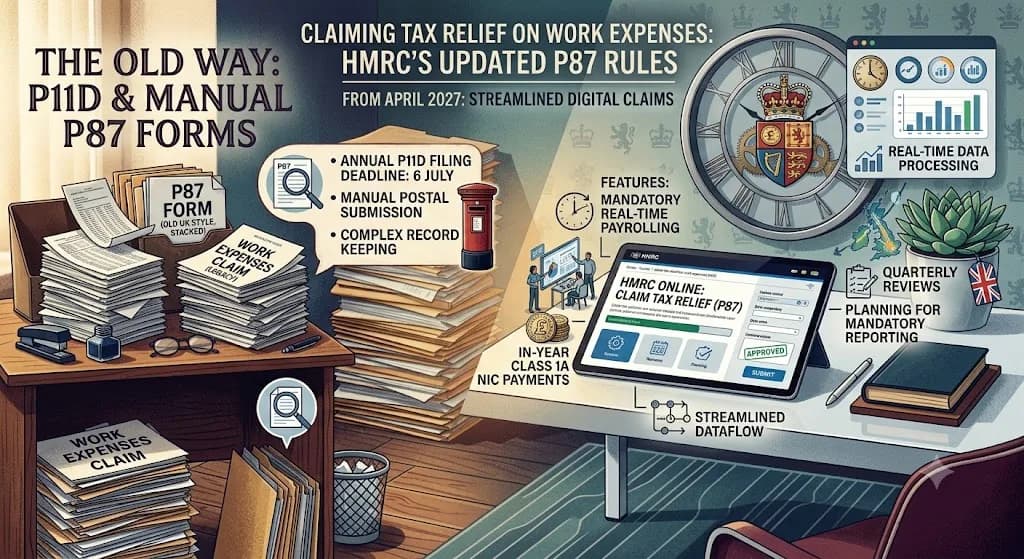
Claiming Tax Relief on Work Expenses: HMRC's Updated P87 Rules
HMRC has updated its P87 guidance and formal directions on what a job expenses claim must contain. Miss the employer…
UK Income Tax Rates and Bands 2026/27: A Plain-English Guide
Understand UK income tax rates and bands for 2026/27, including the Personal Allowance, the basic, higher and additional…
Dividend Tax 2026/27: Allowance, Rates and How Much You'll Pay
A plain-English guide to dividend tax for 2026/27: the £500 allowance, the new higher rates, worked examples and how to…
Rather someone else did it?
Partner linksFixed-fee services where a qualified accountant prepares and files your return.
TaxScouts
A real accountant files your return for one fixed fee.
Fixed fee, typically about £169 per return
Get my return doneGoSimpleTax
DIY Self Assessment software that checks for missed savings.
From about £54.99 per tax year
File it myselfWe may earn a commission if you sign up through one of these links. It never changes what we calculate, what we recommend, or the order they appear in.