
Contents
An electric company car is taxed on 4% of its P11D list price in 2026/27 — so a £45,000 EV creates a taxable benefit of £1,800, costing a basic-rate taxpayer £360 a year and a higher-rate taxpayer £720. That percentage is already legislated to rise to 5% in 2027/28, 7% in 2028/29 and 9% in 2029/30, so an EV taken today gets steadily more expensive but stays far cheaper than a petrol equivalent taxed at up to 37%.
- Zero-emission cars: 4% of list price in 2026/27, 5% in 2027/28, 7% in 2028/29, 9% in 2029/30.
- Your bill is the benefit value multiplied by your marginal income tax rate — 20%, 40% or 45% (19% to 48% in Scotland). There is no employee National Insurance on a company car.
- Your employer pays Class 1A National Insurance at 15% on the same benefit value.
- Plug-in hybrids are banded by electric range, from 3% to 15% — but all 1–50g/km cars jump to a flat 18% in 2028/29.
- Electricity supplied at a workplace charge point is not a taxable benefit, and there is no fuel benefit charge on an electric car.
Electric and hybrid BiK rates by tax year
The "appropriate percentage" is the share of the car's list price that counts as taxable pay each year. For zero-emission cars it climbs by one percentage point a year to 2027/28, then by two points a year after that.
| Tax year | Zero-emission (0g/km) | Plug-in hybrid (1–50g/km) | Maximum rate (petrol/diesel) |
|---|---|---|---|
| 2025/26 | 3% | 3%–15% by electric range | 37% |
| 2026/27 | 4% | 3%–15% by electric range | 37% |
| 2027/28 | 5% | 3%–15% by electric range | 37% |
| 2028/29 | 7% | 18% (flat, all ranges) | 38% |
| 2029/30 | 9% | 19% (flat, all ranges) | 39% |
The list price used is the P11D value: the manufacturer's list price including VAT, delivery and any factory options, but excluding vehicle excise duty and the first registration fee. A capital contribution you make towards the car (up to £5,000) reduces it. If the car is only available to you for part of the year, the benefit is pro-rated by days. Our guide to P11D and benefits in kind covers how the figures reach your tax code.
What an electric company car actually costs
Take the 2026/27 rate of 4% and multiply by your marginal rate. Because the benefit is added to your taxable income, it can also push you into a higher band, so use the figures below as the marginal cost.
| P11D price | Taxable benefit (4%) | Tax at 20% | Tax at 40% | Tax at 45% | Employer Class 1A (15%) |
|---|---|---|---|---|---|
| £30,000 | £1,200 | £240 | £480 | £540 | £180 |
| £40,000 | £1,600 | £320 | £640 | £720 | £240 |
| £50,000 | £2,000 | £400 | £800 | £900 | £300 |
| £60,000 | £2,400 | £480 | £960 | £1,080 | £360 |
| £70,000 | £2,800 | £560 | £1,120 | £1,260 | £420 |
Worked example: £50,000 EV, higher-rate taxpayer
- Benefit value: £50,000 × 4% = £2,000.
- Tax at 40%: £2,000 × 0.40 = £800 a year, or about £67 a month collected through your tax code.
- Employer's Class 1A NI: £2,000 × 15% = £300.
Now run the same car forward: £2,500 benefit in 2027/28 (£1,000 of tax), £3,500 in 2028/29 (£1,400) and £4,500 in 2029/30 (£1,800). Over a four-year lease the tax more than doubles, but compare it with a £40,000 petrol car at 32%: a £12,800 benefit and £5,120 of tax at 40% in a single year.
Scotland
Scottish income tax rates apply to non-savings income, and a company car is non-savings income. On the £2,000 benefit above, a Scottish higher-rate taxpayer pays 42% (£840), an advanced-rate taxpayer 45% (£900) and a top-rate taxpayer 48% (£960). The 4% BiK percentage itself is set UK-wide.
Company car tax on hybrids
Plug-in hybrids emitting 1–50g/km are banded by their official electric-only range. In 2026/27 the bands are:
| Electric range | BiK rate 2026/27 | Benefit on a £50,000 car | Tax at 40% |
|---|---|---|---|
| 130 miles or more | 3% | £1,500 | £600 |
| 70–129 miles | 6% | £3,000 | £1,200 |
| 40–69 miles | 9% | £4,500 | £1,800 |
| 30–39 miles | 13% | £6,500 | £2,600 |
| Under 30 miles | 15% | £7,500 | £3,000 |
Two things matter here. First, a long-range PHEV can be taxed at a lower percentage than a pure EV in 2026/27 — an oddity of the rate freeze. Second, that advantage disappears sharply: from 2028/29 every car in the 1–50g/km bracket moves to a flat 18%, then 19% in 2029/30. On the £50,000 car above, a 3% PHEV goes from £600 of tax at 40% to £3,600. If you are signing a three or four-year deal now, price the later years, not just the first.
Cars over 50g/km are banded by CO2 in 5g/km steps up to the annual maximum. Diesel cars that do not meet the RDE2 standard carry a 4 percentage point supplement, capped at the maximum rate.
Work it out for your own figures
Open the full Company Car Tax Calculator →Your company car
List price incl. VAT and most options, less any one-off capital contribution.
HMRC sets a fixed figure each year (check the current car fuel benefit charge on gov.uk). The fuel benefit = this figure × your BIK %.
Your employer pays Class 1A NI on the total benefit. Confirm the current rate on gov.uk.
Annual company car tax
per month from your pay
- Taxable benefit (BIK)
- Fuel benefit
- Total benefit in kind
- Tax on car
- Tax on fuel
- Your tax - per month
Cost to your employer
Class 1A NI per year on the total benefit (in addition to your own tax).
Estimate only. The BIK % depends on the car's CO₂ emissions - electric cars are very low. Check your band on gov.uk.
Annual tax across CO₂ bands
How your annual tax changes as the BIK percentage rises - a low-emission or electric car can sit at the far left, a high-emission car at the right.
Based on a P11D of at . Your current band is highlighted in the table below.
| BIK % | Taxable benefit | Annual tax | Per month |
|---|---|---|---|
What your Company Car Tax Calculator result means
The Company Car Tax Calculator does more than show a number. Below your result it explains what your figures mean in practice - your effective and marginal rates, any allowances or thresholds you are close to, and the specific steps to take next. Enter your details above and the guidance updates to match your situation.
Do this next, in order
Estimates only - not financial or tax advice. Confirm figures on GOV.UK or with an adviser.
Compare saved cars
| Car | P11D | BIK | Annual tax | Per month | |
|---|---|---|---|---|---|
Charging at work and at home
Electricity is not treated as road fuel for company car purposes, so there is no car fuel benefit charge on a pure electric company car — unlike a petrol or diesel car, where free private fuel creates a separate and often expensive benefit.
- Workplace charging: electricity provided at a charge point at or near your workplace is exempt, for a company car or your own car, provided charging is available to employees generally.
- Home charge point: an employer paying for a charge point to be installed at your home for a company car is covered by an exemption, so there is no benefit in kind.
- Reimbursing home electricity: HMRC accepts that reimbursing the cost of electricity used to charge a company car at home is exempt, as long as the reimbursement relates to that car.
- Your own EV on business trips: you claim mileage, not electricity. HMRC publishes an advisory electricity rate for company cars, which is reviewed quarterly.
Electric company car vs cash allowance
A cash allowance is ordinary pay: it is taxed at your marginal rate and carries employee National Insurance at 8% up to £50,270 and 2% above. A company car carries income tax on the benefit only — no employee NI at all. That gap is what makes a low-BiK EV work.
Worked comparison
A higher-rate taxpayer in England earning above £50,270 is offered either a £6,000 cash allowance or a £50,000 EV through salary sacrifice at £450 a month.
- Cash allowance: £6,000 less 40% tax and 2% NI = £3,480 net to fund a personal lease, insurance, tyres and servicing.
- Salary sacrifice EV: giving up £5,400 of gross pay costs £5,400 × 58% = £3,132 net, plus £800 of BiK tax = £3,932 — usually with insurance, servicing and tyres bundled in.
Whether that is good value depends on the lease rate and what the allowance would really buy. One important detail: the optional remuneration rules that normally tax the higher of the cash forgone and the benefit value do not apply to cars emitting 75g/km or less, which is why EV salary sacrifice keeps the 4% basis. Also remember the benefit reduces your adjusted net income calculation not at all — it increases taxable income, which can matter around the £60,000 to £80,000 High Income Child Benefit Charge range and the £100,000 Personal Allowance taper.
What to do next
Put your own numbers in: the company car tax calculator works out the benefit, your tax and the employer's Class 1A NI for any list price and CO2 figure, across all four years to 2029/30. If you are weighing a car against a cash allowance or salary sacrifice, the company car decision tool compares the net cost of each route. You can also check HMRC's own figures with the company car and fuel benefit calculator on GOV.UK.
Frequently asked questions
How much is company car tax on an electric car in 2026/27?
What are the BiK rates for electric cars in 2026/27 and later years?
How is company car tax on a hybrid worked out?
Do I pay tax on charging my EV at work?
Is an electric company car better than a cash allowance?
Is EV company car tax different in Scotland?
Read next
More Taxes →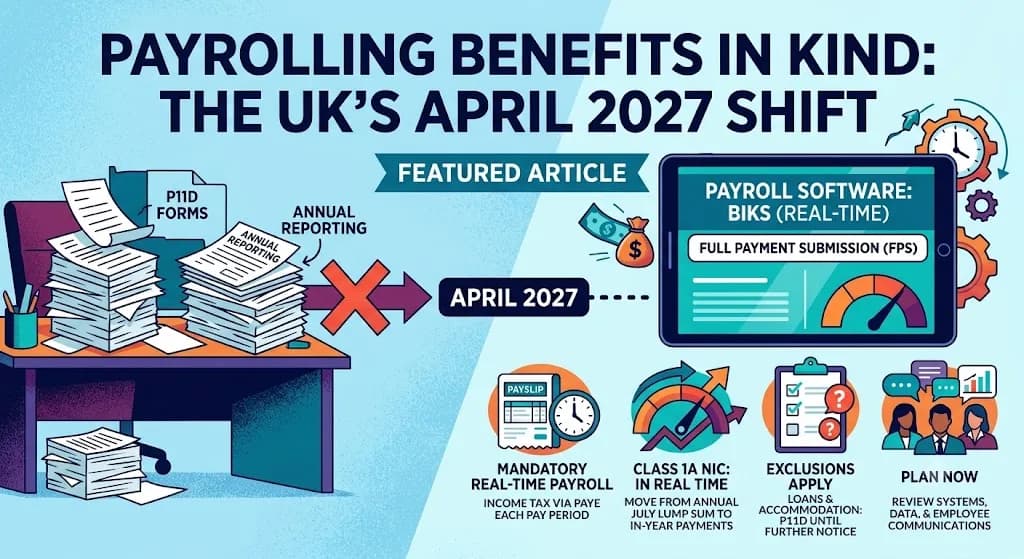
Payrolling Benefits in Kind: What Changes from April 2027
HMRC has confirmed that company cars, fuel and medical benefits must be taxed through payroll from 6 April 2027, with…

UK Income Tax Rates and Bands 2026/27: A Plain-English Guide
Understand UK income tax rates and bands for 2026/27, including the Personal Allowance, the basic, higher and additional…

Dividend Tax 2026/27: Allowance, Rates and How Much You'll Pay
A plain-English guide to dividend tax for 2026/27: the £500 allowance, the new higher rates, worked examples and how to…
Rather someone else did it?
Partner linksFixed-fee services where a qualified accountant prepares and files your return.
TaxScouts
A real accountant files your return for one fixed fee.
Fixed fee, typically about £169 per return
Get my return doneGoSimpleTax
DIY Self Assessment software that checks for missed savings.
From about £54.99 per tax year
File it myselfWe may earn a commission if you sign up through one of these links. It never changes what we calculate, what we recommend, or the order they appear in.