
Contents
- When is the Autumn Budget 2026?
- Why tax is likely to rise even if rates don’t
- Predicted changes: what is on the table
- Income tax: the stealth-tax squeeze
- Dividends and Capital Gains: the likeliest rises
- Pensions: relief in the spotlight
- ISAs and savings
- Immediate versus April: the distinction that matters
- What usually changes at a Budget
- Before Budget day
- On the day
- After the Budget: the window to act
- A worked example of the April window
- How a Budget actually becomes law
- The Scottish and Welsh dimension
- What to ignore
- The measures worth checking personally
- The bottom line
- A note on how to use this
- Where these figures come from
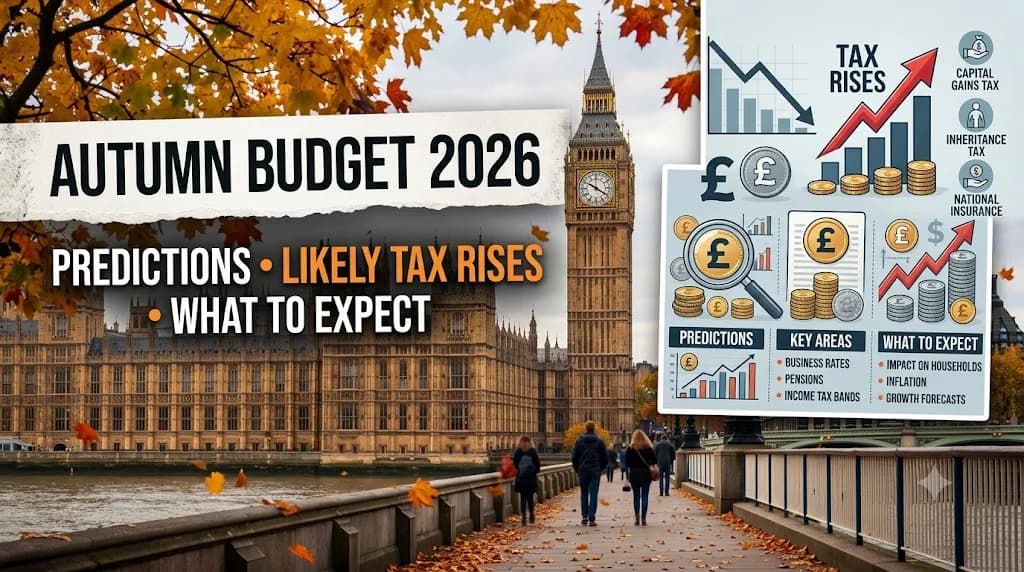
The Autumn Budget 2026 will be the first delivered under Prime Minister Andy Burnham, who took office on 20 July 2026. With the public finances still under pressure and the manifesto pledge not to raise the headline rates of income tax, National Insurance or VAT for “working people”, most forecasters expect the Chancellor to raise revenue through threshold freezes and targeted taxes on wealth, savings, dividends and property rather than the main rates. This guide sets out the likely date, the changes being predicted, and the practical steps you can take now.
When is the Autumn Budget 2026?
No date has been formally confirmed at the time of writing. Based on recent convention, the most likely window is late October to November 2026, with a Wednesday the usual choice. The Office for Budget Responsibility (OBR) forecast is published alongside it. We will update this page the moment the date is announced.
Why tax is likely to rise even if rates don’t
The single biggest revenue-raiser of recent years has not been a rate rise at all — it is the freeze on tax thresholds. The personal allowance (£12,570) and higher-rate threshold (£50,270) have been frozen for years and are currently set to stay frozen. As wages rise, more of your income is dragged into tax and more people cross into the 40% band — a process known as fiscal drag. A freeze extension raises billions without a single rate changing.
See what a freeze means for your own take-home pay as your salary rises:
Predicted changes: what is on the table
| Area | What is being predicted | Who it affects |
|---|---|---|
| Income tax thresholds | Freeze extended beyond 2028 (fiscal drag) | Almost every taxpayer |
| Dividend tax | Higher rates and/or a smaller £500 allowance | Investors, company directors |
| Capital Gains Tax | Rates nudged closer to income tax; allowance held at £3,000 | Landlords, share investors |
| Pensions | Salary-sacrifice NI relief capped; tax-free lump sum reviewed | Higher earners, savers |
| Cash ISAs | Lower cash limit to steer money into investments | Cash savers |
| Property income | Tighter reliefs for landlords | Buy-to-let owners |
Income tax: the stealth-tax squeeze
The clearest prediction is continuity: frozen allowances and thresholds. If you get a pay rise, more of it is taxed, and a rise that tips you over £50,270 exposes the slice above to 40%. The other trap to watch is the £100,000 point, where the personal allowance tapers away and creates an effective 60% marginal rate between £100,000 and £125,140. Pension contributions remain the main legal way to manage both.
Dividends and Capital Gains: the likeliest rises
Because dividend and capital gains taxes sit outside the “working people” pledge, they are the softest targets. Expect pressure on the £500 dividend allowance and the £3,000 CGT annual exempt amount, and possibly higher CGT rates. If you are sitting on gains you intended to realise anyway, using this year’s exemption before 5 April 2027 is a reasonable hedge.
Pensions: relief in the spotlight
Pension tax relief costs the Treasury tens of billions, so it is perennially reviewed. The changes most often floated are a cap on National Insurance relief for salary-sacrifice contributions and a review of the 25% tax-free lump sum. None is confirmed. The practical point: pension contributions are still one of the most powerful reliefs available today, and using this year’s annual allowance is rarely a decision you will regret.
ISAs and savings
A lower cash ISA limit has already been signalled to encourage investment over cash. With savings rates higher than in the 2010s, more ordinary savers are also breaching the Personal Savings Allowance and paying tax on interest for the first time. Check whether your savings interest is now taxable:
Immediate versus April: the distinction that matters
This is the single most useful thing to understand on Budget day, because it determines whether you still have time to act.
| Most measures take effect | 6 April following |
| Duty changes | Often 6pm on the day |
| Anti-avoidance measures | Often immediate |
| Planning window | Budget day to 5 April |
| Allowances to check | ISA, CGT, dividend, pension |
| Consultations | Proposals, not law |
| After new thresholds | Check your tax code |
Effective immediately — typically at midnight or 6pm on Budget day — are measures where advance notice would cause a distortion. Duty changes are the classic example. So are anti-avoidance provisions, and occasionally changes to reliefs where the government wants to prevent a rush of transactions in the intervening weeks. Stamp duty changes have taken effect immediately in the past, which matters enormously if you are mid-purchase.
Effective from the following April — the overwhelming majority. Income tax and National Insurance rates, allowances, ISA and pension limits, and benefit uprating almost always run from the start of the new tax year on 6 April.
That gap is the planning window. If an allowance is being cut from April, you generally have until 5 April to use the current one. That single fact is what makes the days after a Budget worth paying attention to.
What usually changes at a Budget
Budgets vary enormously in scope, but the recurring areas are reasonably predictable:
- Income tax thresholds and rates. Often left nominally unchanged while inflation does the work — see our guide to frozen thresholds, which explains why a freeze is a tax rise in all but name.
- National Insurance rates and thresholds, for employees, employers and the self-employed.
- Allowances — the personal allowance, the CGT annual exempt amount, the dividend allowance, the ISA limit.
- Pension rules — the annual allowance, the tax treatment of lump sums, and the interaction with inheritance tax.
- Property taxes — stamp duty thresholds and the treatment of second homes.
- Duties on fuel, alcohol and tobacco, which frequently change at 6pm on the day itself.
- Benefit rates and the State Pension, usually confirmed for the following April.
Before Budget day
The temptation is to act on speculation. Resist it. Pre-Budget reporting is frequently wrong, and reversing a transaction made on a rumour is expensive and sometimes impossible.
What is genuinely worth doing beforehand:
- Know your own numbers. If you cannot say what your marginal rate is, how much ISA allowance you have left, or whether you are near a threshold, you will not be able to judge whether an announcement affects you.
- Complete anything already planned. If you were going to make a pension contribution or use your CGT allowance anyway, doing it before the Budget removes the risk of an immediate change closing the door.
- Do not make irreversible decisions on speculation. Crystallising a pension lump sum because a newspaper suggested the rules might change is how people create a large tax bill for no reason.
On the day
The statement itself is a summary. The detail sits in the accompanying documents published immediately afterwards, and the detail is frequently where the real effect lies — a headline rate that stays the same while a threshold moves can be a significant tax rise.
Three questions are worth asking of every announcement that seems to affect you: when does it take effect, does it apply to my situation specifically, and is there transitional protection for arrangements already in place? Transitional rules are common and routinely missed in first-day coverage.
After the Budget: the window to act
For measures starting in April, the period between Budget day and 5 April is when planning is actually possible. The recurring opportunities:
- Use this year’s ISA allowance (£20,000) if the limit is being reduced — the current year’s disappears on 5 April regardless, and allowances are rarely clawed back retrospectively.
- Use allowances that are being cut. If the CGT exempt amount or dividend allowance is falling, the current year’s is still available until 5 April. Our guide to Bed and ISA covers how to use a CGT allowance without changing your investments.
- Make pension contributions under existing rules, including any carry forward, if the annual allowance is being restricted.
- Review your salary and dividend mix if you run a company and the rates are changing.
- Check your tax code once new thresholds are confirmed. Codes are updated automatically but errors are common, and an incorrect code costs you money every month until it is fixed. Use the Tax Code Checker.
A worked example of the April window
Suppose a Budget announces that the dividend allowance will fall from 6 April. A company director taking dividends now knows two things: this year’s allowance is unaffected, and next year’s will be smaller.
The useful response is to review the remuneration mix before 5 April — taking dividends within the current year’s allowance where the company has distributable reserves and it makes commercial sense, rather than deferring them into a year with a smaller allowance. The unhelpful response is to take a large dividend simply because the allowance is changing, without regard to whether the income is needed or what band it falls into.
The same logic applies to a reduction in the CGT annual exempt amount, an ISA limit cut, or a restriction to pension relief. In each case the question is the same: is there something I was going to do anyway that is cheaper before April than after? If yes, bring it forward. If no, an announcement is not a reason to act.
That discipline — accelerating planned actions rather than inventing new ones — is what separates useful Budget planning from expensive reaction.
How a Budget actually becomes law
Understanding the process explains why some things can be relied on immediately and others cannot.
The Chancellor delivers the statement, and the supporting documents are published the same day. Measures needing immediate effect are given temporary legal force by resolutions passed shortly afterwards, which is what allows a duty change to bite at 6pm on the day.
The remainder are legislated in a Finance Bill, which then passes through Parliament over the following months. Provisions can be amended or dropped during that passage, and occasionally are. A measure announced in the autumn is not certain until the Bill receives Royal Assent.
In practice, headline rates and allowances announced at a Budget almost always survive intact, and planning around them is reasonable. Technical or contentious measures are the ones that change, which is another argument for acting on confirmed thresholds rather than on announcements of intent.
The Scottish and Welsh dimension
A UK Budget does not settle everything. Scotland sets its own income tax rates and bands on non-savings income, and the Scottish Budget is usually delivered separately in December, taking effect the following April.
That means Scottish taxpayers get their answer weeks after everyone else, and the Scottish bands frequently differ from the UK ones in ways that materially change the arithmetic — particularly in the middle and upper-middle of the range. Our Scotland Tax Calculator applies the Scottish bands to your own figures.
Wales has the power to vary income tax rates but has so far kept them aligned with England and Northern Ireland. Both Scotland and Wales set their own property transaction taxes — LBTT and LTT respectively — so a stamp duty announcement at a UK Budget does not apply in either nation.
National Insurance, capital gains tax, dividend tax, inheritance tax and pension rules remain UK-wide, so those parts of a Budget apply everywhere.
What to ignore
Two categories of Budget coverage are reliably unhelpful.
Consultations announced but not enacted. A consultation is a proposal, sometimes years from becoming law and frequently abandoned. Treating one as a decided fact leads to premature action.
Figures presented without a baseline. “The average family will be £X better off” is a political claim, not a calculation you can apply to yourself. Run your own numbers with the Tax Calculator once the actual thresholds are confirmed.
The measures worth checking personally
Rather than reading everything, check the handful that apply to your circumstances.
If you are employed: income tax thresholds, National Insurance, and the personal allowance. If you are self-employed: Class 2 and Class 4 National Insurance, and anything affecting Making Tax Digital timing. If you are retired or approaching it: the State Pension uprating, pension tax rules, and the savings and dividend allowances. If you own property: stamp duty, and the treatment of rental income and second homes. If you run a company: corporation tax, employer National Insurance, and the dividend rates that determine your remuneration mix.
Our Budget hub collects the changes as they are confirmed, and the Tax Deadline Tracker covers the dates that follow.
The bottom line
Expect the 2026 Budget to raise money quietly — through frozen thresholds and higher taxes on dividends, gains, savings and property — rather than through headline rate rises. The winning strategy is boring but effective: use your current-year allowances, keep contributing to pensions and ISAs, and revisit the detail here once the Chancellor stands up. We update this guide as each prediction is confirmed or dropped.
A note on how to use this
This guide explains the rules as they stand for the 2026/27 tax year and is written to help you understand your own position. It is general information, not personal financial advice — your circumstances change the answer, sometimes completely. For a decision that matters, speak to a regulated adviser or check directly with HMRC. Our calculation methodology sets out where every figure on this site comes from.
Where these figures come from
Every rate and threshold on this page is checked against HMRC’s published guidance for the 2026/27 tax year. If you spot a figure that looks out of date, please tell us.
Frequently asked questions
When is the Autumn Budget 2026?
Will income tax go up in the Autumn Budget 2026?
What taxes are most likely to increase?
How can I prepare for the Budget?
Read next
More Taxes →
How to Calculate Your Take-Home Pay After Tax and National Insurance (2026/27)
Your salary and what actually lands in your bank account are two different numbers. Here's exactly how to work out your…

PAYE vs Self-Employed: Which Leaves You Better Off?
Comparing PAYE vs self employed is about more than the headline figure. We break down how income tax, National…

How Much Tax Will I Pay on a £50,000 Salary? (2026/27)
On a £50,000 salary in England, Wales or NI for 2026/27 you take home about £39,520 a year (£3,293 a month) after tax…
Rather someone else did it?
Partner linksFixed-fee services where a qualified accountant prepares and files your return.
TaxScouts
A real accountant files your return for one fixed fee.
Fixed fee, typically about £169 per return
Get my return doneGoSimpleTax
DIY Self Assessment software that checks for missed savings.
From about £54.99 per tax year
File it myselfWe may earn a commission if you sign up through one of these links. It never changes what we calculate, what we recommend, or the order they appear in.